



Abstract
Microcanonical thermodynamics studies the operations that can be performed on systems with well-defined energy. So far, this approach has been applied to classical and quantum systems. Here we extend it to arbitrary physical theories, proposing two requirements for the development of a general microcanonical framework. We then formulate three resource theories, corresponding to three different sets of basic operations: (i) random reversible operations, resulting from reversible dynamics with fluctuating parameters, (ii) noisy operations, generated by the interaction with ancillas in the microcanonical state, and (iii) unital operations, defined as the operations that preserve the microcanonical state. We focus our attention on a class of physical theories, called sharp theories with purification, where these three sets of operations exhibit remarkable properties. Firstly, each set is contained into the next. Secondly, the convertibility of states by unital operations is completely characterised by a majorisation criterion. Thirdly, the three sets are equivalent in terms of state convertibility if and only if the dynamics allowed by theory satisfy a suitable condition, which we call unrestricted reversibility. Under this condition, we derive a duality between the resource theories of microcanonical thermodynamics and the resource theory of pure bipartite entanglement.

Original content from this work may be used under the terms of the Creative Commons Attribution 3.0 licence. Any further distribution of this work must maintain attribution to the author(s) and the title of the work, journal citation and DOI.
1. Introduction
In recent years, developments in the field of nanotechnology have raised questions about thermodynamics away from the thermodynamic limit [1–17]. One way to address this new regime is to adopt a resource-theoretic approach [18, 19], which starts from a subset of operations that are regarded as ‘free’ or ‘easy to implement’ [20–23]. A number of results in quantum thermodynamics have been obtained through this approach [24–35], unveiling new connections between thermodynamics and information theory [36–42].
The most basic instance of thermodynamics is for systems with definite energy. There, the natural choice of free state is the microcanonical state, i.e. the uniform mixture of all states with the same energy. In situations where the experimenter lacks control over the preparation of the system, it is natural to expect that the system’s state will fluctuate randomly from one experiment to the next, so that the overall statistics is described by the microcanonical state. The choice of free operations is less obvious. The three main choices considered in the literature on quantum thermodynamics are:
- 1.
- 2.
- 3.
These three sets are strictly different: the set of random unitary channels is strictly contained in the set of noisy operations [51], and the latter is strictly contained in the set of unital channels [52]. In spite of this, the three sets are equivalent in terms of state convertibility [48]. This means that all the natural candidates for the sets of free operations induce the same notion of resource. This resource is generally called purity, and plays a fundamental role in many quantum protocols [53].
In this paper we extend the paradigm of microcanonical thermodynamics from quantum theory to arbitrary physical theories [54–61]. We propose two minimal requirements a probabilistic theory must satisfy in order to support a microcanonical description, and, when these requirements are satisfied, we provide a general operational definition of random reversible, noisy, and unital operations. We then focus on a special class of theories, called sharp theories with purification, which are appealing for the foundations of thermodynamics [62], and have also been studied for their computational power [63, 64] and interference properties [65]. In sharp theories with purification, we show that the three sets of operations satisfy the same inclusion relations as in quantum theory, with random reversible operations included in the set of noisy operations, and noisy operations included in the set of unital operations. For unital operations, we characterise the convertibility of states completely in terms of a suitable majorisation criterion. Thanks to this fact, one can take advantage of majorisation theory and develop quantitative measures of resourcefulness under unital operations. We call these measures unital monotones and show that they are in one-to-one correspondence with Schur-convex functions [66].
Majorisation is a necessary and sufficient condition for state convertibility under unital operations. For random reversible and noisy operations, however, majorisation is only necessary, as we illustrate explicitly with a counterexample. Majorisation becomes sufficient if and only if the dynamics allowed by the theory satisfy a suitable requirement, which we call unrestricted reversibility. When this is the case, the sets of random reversible, noisy, and unital operations define the same notion of resource. Moreover, one can prove the validity of an entanglement-thermodynamics duality [67], which connects the three resource theories of purity and the resource theory of pure bipartite entanglement. All these results identify sharp theories with purification and unrestricted reversibility as a privileged spot in the space of all possible physical theories. In this spot, thermodynamic and information-theoretic features interact in a very similar way as they do in quantum mechanics.
The paper is structured as follows. In section 2 we briefly review the framework, and in section 3 we introduce constrained theories, a natural setting where to develop microcanonical thermodynamics. In section 4 we propose two basic requirements for a well-posed microcanonical thermodynamics in general physical theories, and in section 5 we extend the three resource theories of random reversible, noisy, and unital operations from quantum theory to arbitrary probabilistic theories. In section 6 we introduce the axioms and discuss their basic consequences for the class of theories we study. The implications of the axioms for microcanonical thermodynamics are examined in section 7. In section 8 we establish majorisation as a necessary and sufficient condition for the convertibility of states under unital operations, and we characterise the corresponding monotones in terms of Schur-convex functions. Remarkably, majorisation is not a sufficient criterion for convertibility under random reversible channels; we show a counterexample in section 9. In section 10 we determine when the three resource theories are equivalent in terms of state convertibility. Finally, in section 11 we establish the duality between the three resource theories of microcanonical thermodynamics and the resource theory of entanglement. Conclusions are drawn in section 12.
2. Framework
Toy models of physical theories beyond classical and quantum mechanics can be formulated in the language of general probabilistic theories [54–61], an umbrella term used to describe frameworks dealing with the notions of state, transformation, and measurement, along with a set of rules to assign probabilities to measurement outcomes. Specifically, this paper adopts the framework known as operational-probabilistic theories (OPTs) [57–59, 61, 68–71]. The OPT framework differs from other frameworks for general probabilistic theories, such as the convex set framework [55, 72–74], in the particular way it treats the composition of systems. While in the convex set framework one generally starts from convex sets associated with individual systems, and builds composites from them, the OPT framework takes the composition of physical processes as primitive. Mathematically, the ‘top-down’ approach of the OPT framework is underpinned by the graphical language of circuits [75–80]. In this section we give an informal presentation, referring the reader to the original articles for a more in-depth discussion.
2.1. States, transformations, and measurements
OPTs describe the experiments that can be performed on a given set of systems by a given set of physical processes. The framework is based on a primitive notion of composition, whereby every pair of physical systems  and
 can be combined into a composite system, denoted by
 . Physical processes can be connected in sequence or in parallel to build circuits, such as

In this example,  ,
 , and
 are systems, ρ is a bipartite state,
 ,
 and
 are transformations, a and b are effects. Note that inputs are on the left and outputs are on the right.
For generic systems  and
 , we denote by
-
 the set of states of system ,
-
the set of effects on ,
-
the set of transformations from to , and by the set of transformations from to ,
-
(or , for short) the sequential composition of two transformations and , with the input of matching the output of ,
-
the identity transformation on system , represented by the plain wire
-
the parallel composition (or tensor product) of the transformations and .


Among the list of valid physical systems, every OPT includes the trivial system  , corresponding to the degrees of freedom ignored by theory. The trivial system acts as a unit for the composition of systems: for every system
 , one has
 .
States (resp. effects) are transformations with the trivial system as input (resp. output). Circuits with no external wires, like the circuit in equation (1), are called scalars. We will often use the notation  to denote the scalar

and of the notation  to denote the scalar

In the OPT framework, the scalar  is identified with a real number in the interval
 , interpreted as the probability of a joint occurrence of the state ρ and the effect a in an experiment consisting of a state preparation (containing ρ as one of the possible states), followed by a measurement (containing a as one of the possible effects).
The fact that scalars are real numbers induces a notion of sum for transformations, so that the sets  ,
 , and
 become spanning sets of real vector spaces. By dimension of the state space
 , we mean the dimension of the vector space spanned by the states of
 .
2.2. Tests and channels
In general, a physical process can be non-deterministic, i.e. it can result into a set of alternative transformations, heralded by different outcomes, which can (at least in principle) be accessed by an experimenter. General non-deterministic processes are described by tests: a test from  to
 is a collection of transformations
 from
 to
 , where
 is the set of outcomes. If
 (resp.
 ) is the trivial system, the test is called a preparation-test (resp. observation-test). If the set of outcomes
 contains a single element, we say that the test is deterministic, because one, and only one transformation can take place. We will denote the sets of deterministic states, transformations, and effects as
 ,
 , and
 respectively. We refer to deterministic transformations as channels.
A transformation  from
 to
 is called reversible if there exists another transformation
 from
 to
 such that
 and
 . It is not hard to see that reversible transformations are deterministic, i.e. they are ‘channels’. If there exists a reversible transformation transforming
 into
 , we say that
 and
 are operationally equivalent, denoted by
 . Physically, this means that every experiment performed on system
 can be (at least in principle) converted into an experiment on system
 , and vice versa. The composition of systems is required to be symmetric, meaning that
 . Physically, this means that for every pair of systems
 and
 there exists a reversible transformation that swaps
 with
 .
2.3. Pure transformations
The notion of pure transformation plays centre stage in our work. Intuitively, pure transformations represent the most fine-grained processes allowed by the theory. To make this intuition precise, we need a few definitions.
The first definition is coarse-graining—the operation of joining two or more outcomes of a test into a single outcome: the test  is a coarse-graining of the test
 if there exists a partition
 of
 such that

We say that the test  is a refinement of the test
 . A transformation
 with j in the set
 is a refinement of the transformation
 .
Pure transformations are the most refined transformations:
Definition 1. A transformation  is pure if it has only trivial refinements, namely refinements
 of the form
 , where
 is a probability distribution.
We denote the sets of pure transformations, pure states, and pure effects as  ,
 , and
 respectively. As usual, non-pure states are called mixed.
2.4. Purification
Another key notion in our paper is the notion of purification [57, 59]. Consider a bipartite system  in the state
 . The state of system
 alone is obtained by discarding system
 —that is, by applying a channel that transforms system
 into the trivial system. Discarding operations are represented by deterministic effects, i.e. deterministic transformations with trivial output. In quantum theory, every system has one and only one deterministic effect, corresponding to the partial trace on the Hilbert space of the system.
Given a deterministic effect  , the corresponding marginal state is

or, in formula,  .
When  is pure and equation (5) is satisfied for some deterministic effect e, we say that
 is a purification of
 and we call
 the purifying system [57, 59].
Definition 2. A purification  is essentially unique [59] if for every pure state
 and every deterministic effect
 satisfying the purification condition

one has

and

for some reversible transformation  .
In a completely general theory, there may be different ways to discard a system, corresponding to different deterministic effects. The deterministic effect is unique in causal theories, that is, theories where no signal can be sent from the future to the past [57].
2.5. Finiteness, closure, and convexity
In this paper we will make three standing assumptions. The first assumption is that our OPT describes finite systems, i.e. systems for which the state space is finite-dimensional. Operationally, this means that the state of each system is uniquely determined by the statistics of a finite number of finite-outcome measurements.
Our second assumption is that the space of transformations (and the spaces of states and effects, in particular) is closed under limits. Physically, this expresses the fact that a limit of operational procedures is itself an operational procedure, whereby the target transformation can be implemented with arbitrary accuracy. Mathematically, a sequence of transformations  from
 to
 converges to the transformation
 if for every reference system
 , every state
 , and every effect
 the probabilities
 converge to the probability
 .
The third standing assumption made throughout the paper is that the space of transformations  is convex for every
 and
 . Mathematically, this means that one has the implication

Physically, this means that the experimenter can perform arbitrary randomised operations. Note that convexity is a natural assumption in every non-deterministic theory: provided that some experiment yields random outcomes, one can always repeat that experiment many times and approximate every probability distribution [57]. Then, the closure assumption guarantees that the limit probability distribution is also achievable within the theory. Thanks to this fact, the experimenter can perform arbitrary randomised tests.
3. Theories of systems with constraints
The language of general probabilistic theories is largely interpretation-independent. As such, it has the flexibility to model very different physical scenarios, or even to model different fragments of the same physical theory. In this paper we use the framework to model scenarios of microcanonical thermodynamics, where the systems under consideration have a well-defined energy. More generally, the microcanonical approach can be applied to systems with additional constraints—e.g. to systems of particles confined in a given volume, or constrained to have a fixed value of the angular momentum. In these scenarios, the microcanonical state is interpreted as the state of ‘minimum information’ compatible with the constraints. In this section we outline how the OPT framework can be used to describe physical systems subject to constraints.
3.1. Constrained systems in quantum theory
Before delving into general theories, it may help to analyse the example of quantum theory. Let us consider first the case of a quantum system  constrained to a fixed value of the energy. The constraint is implemented by specifying the system’s Hamiltonian
 and by restricting the allowed states to (mixtures of) eigenstates of the Hamiltonian for a fixed eigenvalue, say E. The quantum states compatible with the constraint are the density matrices ρ satisfying the condition

where PE is the projector on the eigenspace of  with eigenvalue E.
For example, the system  could be an electron in a hydrogen atom, in the absence of external fields. In general, the basis states of the electron are labelled as
 , where
 , and ms are the principal, orbital, magnetic, and spin quantum number respectively. The electron may be constrained to the lowest energy shell, corresponding to n = 1 and
 . In this case, the allowed states are contained in a two-dimensional subspace, spanned by the ‘spin-up’ and ‘spin-down’ states
 and
 , Under this restriction, the electron’s spin can be regarded as an effective qubit.
Constraints other than energy preservation can be treated in a similar way. We consider constraints of the form

where  is a linear map on the state space of the system. This form is suggested by equation (10), where the linear map is
 ,
 being the identity channel on system
 .
Given a set of constraints  , one can define an effective system, whose states are the density matrices ρ satisfying the conditions
 for every i. The constrained quantum system can be denoted as
 , where
 is the original system and
 are the linear maps representing the constraints. The physical transformations of the effective system are the physical transformations of
 that send every input state satisfying the constraint into an output state satisfying the constraints. For the energy constraint (10), this means that the transformations of the effective systems should be energy-preserving.
A familiar example of effective system is the polarisation of a single photon. At the fundamental level, the single photon is just an excitation of the electromagnetic field, e.g. corresponding to the wave vector  . One can regard the single photon as an effective system by restricting the attention to the two-dimensional space spanned by the states
 and
 , corresponding to vertical and horizontal polarisation, respectively. In this case, we can see two constraints working together: a constraint on the wave vector and a constraint on the energy of the field. Note that the effective description in terms of single photons is accurate only as long as the dynamics of the field is confined into the ‘single-photon subspace with wave vector
 ’.
So far, we have defined effective systems at the single-system level. An important question is how to define the composition of effective systems. Consider two effective systems  and
 , where
 and
 are the original, unconstrained systems. A natural way to define the effective composite system
 is to select the states of the unconstrained composite system
 that satisfy both constraints—i.e. to select the density matrices ρ such that

When the effective systems  and
 result from an energy constraint, the effective system
 describes a system consisting of two parts, each of which with its own, well-defined energy. In this case, the constraints (12) can be summarised in a single equation, namely

where  and
 are the energies of the two local systems, and
 and
 are the projectors on the corresponding eigenspaces.
One might be tempted to define the composite system  in a different way, without imposing that each individual part has a definite energy. Indeed, one could imagine that, when the two systems
 and
 are brought into contact, they start exchanging energy, with the only constraint that the total energy has to remain constant. The resulting states would be density matrices that satisfy the (generally) weaker condition

where  is the projector on the eigenspace of
 with eigenvalue
 . The reason why we do not make such a choice can be illustrated with a simple example. Suppose that
 and
 are two spatial modes of the electromagnetic field, with wave vectors
 and
 , respectively. Systems
 and
 could be single photons, i.e. effective systems corresponding to states of the field in the first excited level. Now, if the energy of the two modes is the same, an energy-preserving evolution could transform the initial state
 into the state

States of this kind cannot be interpreted as states of two single photons. Note that, instead, the constraint (12) correctly identifies the correct set of states—including, among others, entangled states such as the Bell state

Motivated by this and by similar examples, we reserve the notation  for effective systems defined by the constraint (12). Other effective systems, like the system defined by the constraint (14), can be treated in our framework, but will be regarded as different from the product system
 .
3.2. Constrained systems in general theories
The construction outlined in the quantum case can be easily extended to arbitrary physical theories. A constraint for system  can be defined as an element
 of the real vector space
 spanned by the physical transformations in
 . The constraint is satisfied by the states ρ such that

For a given set of constraints  , one can define an effective system
 . The states of the effective systems are defined as

The transformations of the effective system  are those transformations of
 that send states of
 to states of
 . The measurements on
 are just the measurements on
 , restricted to the states in
 .
For two effective systems,  and
 , we define the composite system
 to be the effective system

This definition is consistent with interpretation of system  as a composite system made of two, independently addressable parts
 and
 . For example, local measurements on one side of a bipartite state of
 induce states of the correct system (either
 or
 ) on the other side.
3.3. Effective theories
Given a theory and a set of constraints composed as in equation (19), one can build a new effective theory, which consists only of effective systems. For example, one can build an effective theory where every system has definite energy, and where every composite systems consist of subsystems with definite energy. For a given system  in such a theory, all the states in
 have—by fiat—the same energy. Likewise, all the transformations in
 will be—by fiat—energy-preserving. For every pair of systems
 and
 , the composite system
 consists of two parts, each of which with its own, well-defined energy. The joint transformations in
 will be interpreted as operations that preserve the energy of the first part and the energy of the second part.
One benefit of the effective picture is that one does not need to specify the constraints—in principle, every linear constraint can fit into the framework. In this way, we can circumvent the thorny issue of defining the notion of Hamiltonian in general probabilistic theories (see [62]): in the effective description, we can simply regard each effective system as a system with trivial Hamiltonian, which assigns the same energy to all states of the system.
4. The microcanonical framework
In this section we build a microcanonical framework for general physical theories. We will adopt the effective description, wherein every system is interpreted as the result of a constraint—typically, but not essentially, a constraint on the energy.
4.1. The principle of equal a priori probabilities
The starting point of the microcanonical approach is the principle of equal a priori probabilities, stating that one should assign the same probability to all the microstates of the system compatible with a given macrostate. In our language, the ‘microstates’ are the deterministic pure states, representing those preparations of the system that are both deterministic and maximally fine-grained. The ‘macrostate’ is specified by a constraint, such as the constraint of fixed energy. The principle of equal a priori probabilities states that the system should be described by a uniform mixture of all deterministic pure states satisfying the constraint. For example, the microcanonical state of a (finite-dimensional) quantum system at energy E is described by the density matrix

where  is the manifold of pure states in the eigenspace of the system’s Hamiltonian corresponding to the eigenvalue E, and
 is the uniform probability distribution over
 . In the effective picture, the microcanonical state is nothing but the maximally mixed state

where  is the uniform probability distribution over the pure states of the system.
A traditional problem in the foundations of statistical mechanics is to determine the conditions under which the principle of equal a priori probabilities holds. Here we will not delve into this problem, which involves a great deal of detail about the physics of the system and of its dynamics. Instead, we will focus on the general conditions that must be satisfied in order to formulate the principle of equal a priori probabilities in physical theories other than classical and quantum mechanics.
In general probabilistic theories, the key problem is to define what we mean by ‘equal a priori probabilities’. In quantum mechanics, there is a canonical choice: the unitarily invariant probability distribution on the pure states of the system. The obvious extension to general theories is to consider the probability distributions that are invariant under all reversible transformations. The problem is, however, that there may be more than one invariant probability distribution. This point is illustrated in the following example:
Example 1. Consider a toy theory where the space of the deterministic states of one of the systems is a half-disk in the two-dimensional plane, as in figure 1(a). For this system, the pure states are the states on the half-circle (in green in the figure), and can be parameterised with a polar angle θ between 0 and π. Now, the reversible transformations send deterministic states into deterministic states and, therefore, must be symmetry transformations of the state space. For the half-disk, the only symmetry transformations are the identity transformation and the reflection around the symmetry axis (in black in the figure). Hence, every probability distribution that assigns the same probability distribution to the points θ and  is guaranteed to be invariant under reversible transformations. This means that the notion of ‘equal a priori probabilities’ is not uniquely defined. The situation would be different if the state space of the system were a full disk, as illustrated in figure 1(b). In this case, every rotation of the disk could be (at least in principle) a reversible transformation of the system. The invariant probability distribution would be unique, and given by the probability density
 .
Note that in the above examples we only specified the state space and the transformations of a single system, without giving the full-blown OPT. It is easy to see that such a theory does indeed exist. In general, one can always build a ‘minimal OPT’ that includes a given system with a given state space, a given set of transformations, and a given set of measurements. The construction was shown in [81, example 2]. In the minimal OPT, the composite systems are made of many copies of the given system, and their allowed states, transformations, and operations are (mixtures of) product states, product transformations, and product operations.

Figure 1. Two different sets of deterministic states. For the set in figure 1(a), the pure states form a half-circle (in green). Owing to the limited symmetry of the state space, there is no canonical notion of equal a priori probability on the manifold of pure states. For the set in figure 1(b), the pure states form a full circle, and the notion of uniform probability distribution is uniquely defined.
Download figure:
Standard image High-resolution imageThe above example shows that there exist probabilistic theories where the notion of ‘equal a priori probabilities’ on pure states is not uniquely defined. In order to formulate the principle of equal a priori probabilities, we put forward the following requirement:
Requirement 1. For every (finite) system there exists a unique invariant probability distribution on the deterministic pure states.
This requirement is far from trivial. In fact, it is equivalent to an important property, independently considered in the literature on the axiomatisation of quantum theory [54, 82–84]:
Theorem 1. For every finite system  , the following are equivalent:
- 1.There exists a unique invariant probability distribution on the deterministic pure states of system.
- 2.Every deterministic pure state of system can be obtained from every other deterministic pure state of the same system through a reversible transformation.


Proof. The idea of the proof is that the set of deterministic pure states of system  can be decomposed into a disjoint union of orbits generated by the group of reversible transformations. More formally, for every two (deterministic) pure states α and
 , one can define the equivalence relation
 if
 for some reversible transformation
 . In this way, the set of deterministic pure states is partitioned into equivalence classes, known as homogeneous spaces. Moreover, each homogeneous space is a closed set, because the group of reversible transformations is closed [57] and has a finite-dimensional representation on the state space of system
 . Now, one can define an invariant probability distribution for every equivalence class. Indeed, it is enough to define the invariant measure on the pure states induced by the invariant measure on the group of reversible transformations. Hence, the condition that there is only one invariant probability distribution implies that there must be only one equivalence class. In other words, every two pure states are connected by a reversible transformation.
Conversely, if there is only one equivalence class for the relation  there is only one invariant probability distribution. This is because the normalised invariant measure on a homogeneous space is uniquely defined.■
The mutual convertibility of pure states under reversible transformations was introduced by Hardy [54] as an axiom for the derivation of quantum theory and has been assumed, either directly or indirectly, in all the recent derivations inspired by quantum information theory (see [68, 70, 82, 83] and the contributed volume [60] for an overview). Theorem 1 provides one more motivation for the convertibility of pure states, identified as the necessary condition for the formulation of the principle of equal a priori probabilities.
4.2. The microcanonical state
Every theory satisfying requirement 1 has a canonical notion of ‘uniform distribution over the pure states of the system’. We can then apply the principle of equal a priori probabilities and define the microcanonical state as the uniform mixture

where  the invariant probability distribution over the deterministic pure states of system
 .
The convexity of the state space guarantees that the microcanonical state is indeed a state. Moreover, since the state space is finite-dimensional, it is possible to replace the integral in equation (22) with a finite sum. This means that the microcanonical state can (in principle) be generated by picking deterministic pure states at random from a finite set.
The microcanonical state has two important properties, proved in appendix A:
- 1.it is invariant under arbitrary reversible dynamics of the effective system;
- 2.it can be generated from every other deterministic pure state of the effective system through a random reversible dynamics.
Property 1 expresses the fact that the microcanonical state is an equilibrium state, in the sense that it does not evolve under any of the reversible dynamics compatible with the constraints. Note that the notion of equilibrium here is different from the notion of thermal equilibrium, which refers to interactions with an external bath. Instead of thermal equilibrium, we consider here a dynamical equilibrium, consisting in the fact that the probability assignments made by the microcanonical state are stable under all possible evolutions of the system.
Property 2 refers to the fact that the system can—at least in principle—be brought to equilibrium. Physically, we can imagine a situation where the experimenter has no control on the system’s preparation, but has control on the system’s dynamics through some classical control fields. In this picture, property 2 guarantees that the experimenter can prepare the microcanonical state by drawing at random the parameters of her control fields. Further along this line, one can also imagine scenarios where the randomisation occurs naturally as a result of fluctuations of the fields. Property 2 is important from the resource-theoretic approach, where the microcanonical state is often regarded as free, or ‘easy to prepare’.
4.3. Composition of microcanonical states
At the level of single systems, requirement 1 guarantees the existence of a microcanonical state. But how does the microcanonical state behave under the composition of systems? Traditionally, this question is not addressed in textbook presentations, where the microcanonical state is associated with isolated systems, i.e. systems that do not interact with other systems. From the operational point of view, however, it is natural to consider scenarios where the experimenter has more than one system at her disposal.
Composition is especially important in the context of resource theories, where it is natural to ask how resources interact when combined together. To illustrate this point, it is useful to consider the quantum resource theory of noisy operations [46–48]. There, the microcanonical states are treated as free. Since the experimenter can generate the microcanonical states  and
 at no cost, then she can generate the product state
 at no cost too. If we insist that the microcanonical states are the only free states in the resource theory of noisy operations, the product state
 must be the microcanonical state of the composite system
 —in formula,

Equation (23) is consistent with the intuitive interpretation of the microcanonical state as ‘the state of minimum information compatibly with the constraints’. Indeed, equation (23) amounts to saying that, if one has minimum information on the parts of a system, then one has minimum information about the whole. This is indeed the case in quantum theory, where the product of two maximally mixed states is maximally mixed. Recall that here we are dealing with effective systems, which exist only as long the corresponding constraints are enforced. For energy constraints, the composite of two effective systems  and
 is defined as a system consisting of two parts, each constrained to a specific value of the energy. Consistently with this interpretation, the microcanonical state of system
 is the ‘maximally mixed state’ in the manifold of quantum states with fixed local energies, as defined in equation (13).
Following the example of quantum mechanics, we require that minimum information about the parts imply minimum information about the whole:
Requirement 2. The microcanonical state of a composite system is the product of the microcanonical states of its components. In formula:

for every pair of effective systems  and
 .
We call equation (24) the condition of informational equilibrium. Note that, again, here we are not referring to thermal equilibrium between the two subsystems. This is clear from the fact that we do not allow an energy flow between the two systems  and
 . Instead, we allow a flow of information, implemented by the joint dynamics of the composite system
 .
It is natural to ask which physical principles guarantee the condition of informational equilibrium. One such principle is local tomography [54, 55, 57], namely the requirement that the state of multipartite systems be determined by the joint statistics of local measurements. However, local tomography is not necessary for informational equilibrium. For example, quantum theory on real Hilbert spaces violates local tomography, but still satisfies the condition of informational equilibrium. In this paper, we will not assume local tomography in our set of physical principles. Nevertheless, our principles will guarantee the validity of the condition of informational equilibrium.
4.4. Microcanonical theories
We are now ready to extend the microcanonical framework from quantum and classical theory to general physical theories.
Definition 3. An operational-probabilistic theory, interpreted as a theory of effective systems, is microcanonical if requirements 1 and 2 are satisfied.
Physically, a microcanonical theory is a theory where (i) every system has a well-defined notion of uniform mixture of all pure states, and (ii) uniform mixtures are stable under parallel composition of systems. Microcanonical theories provide the foundation for the definition of three important resource theories, analysed in the following sections.
5. Three resource theories
In this section we study three different notions of state convertibility in microcanonical theories. We adopt the resource-theoretic framework of [20, 21], where one fixes a set of free operations, closed under sequential and parallel composition. A basic question in the resource-theoretic framework is whether a given state ρ can be transformed into another state σ by means of free operations. When this is possible, ρ is regarded as ‘more resourceful’ than σ, denoted as  , where
 is the set of free operations. Mathematically, the relation
 is a preorder on the states.
In the following we define three resource theories and their corresponding preorders.
5.1. The random reversible (RaRe) resource theory
Our first resource theory is based on the notion of random reversible channel [67]:
Definition 4. A RaRe channel on system  is a channel
 of the form
 , where
 is a probability distribution and, for every i,
 is a reversible channel on system
 .
Physically, RaRe channels are the operations that can be implemented with limited control over the reversible dynamics of the system. Mathematically, it is immediate to check that RaRe channels have all the properties required of free operations: the identity channel is RaRe, the sequential composition of two RaRe channels is a RaRe channel, and so is the parallel composition. We call the resulting resource theory the RaRe resource theory, and we denote by  the corresponding preorder.
Note that the RaRe resource theory can be formulated in every OPT, even in OPTs that do not satisfy requirements 1 and 2. Such generality, however, comes at a price: the RaRe resource theory has no free states. This is because states are operations with trivial input, while the only free operations in the RaRe theory are transformations where the input and the output coincide.
Despite not having free states, the RaRe resource theory can have minimally resourceful states, defined as follows
Definition 5. In a resource theory with free operations  , a state ρ is minimally resourceful if the condition
 implies
 .
In the RaRe resource theory, minimally resourceful states are easy to characterise:
Proposition 1. A state is minimally resourceful in the RaRe resource theory if and only if it is invariant under the action of reversible transformations.
Proof. By definition, one has  for every state ρ and for every reversible transformation
 . If ρ is minimally resourceful, one must have
 . Hence, ρ must be invariant under arbitrary reversible transformations.
Conversely, suppose that ρ is invariant, and that  . By definition, this means that
 , for some RaRe channel
 . Since ρ is invariant, it must satisfy the relation
 . Hence,
 .■
For theories satisfying requirement 1, proposition 1 implies that the microcanonical state is minimally resourceful: indeed, we know that the microcanonical state is invariant under reversible transformations.
5.2. The noisy resource theory
While the RaRe resource theory can be defined in every OPT, we now discuss a second resource theory that can only be defined in physical theories satisfying requirements 1 and 2. In this resource theory, free operations are generated by letting the system interact with ancillas in the microcanonical state. These operations, usually called ‘noisy’ [46–48], are defined as follows:
Definition 6. A channel  , from system
 to system
 , is a basic noisy operation if it can be decomposed as

where  and
 are suitable systems such that
 ,
 is a reversible transformation, and e is a deterministic effect, representing a possible way to discard system
 .
Note that here we only allow reversible transformations, instead of mixtures of reversible transformations. In principle, one could consider arbitrary RaRe channels, as in the previous subsection. The main reason why we stick to reversible transformations (without randomisation) is that we want to be consistent with the existing literature [46–48]. Note also that definition 6 is interesting per se, because it does not rely on the availability of external sources of randomness: instead, all the randomness is accounted for in the preparation of the microcanonical state in the right-hand side of equation (25).
Definition 6 has a slightly unpleasant aspect: the set of basic noisy operations is generally not closed. In quantum theory, for example, there exist counterexamples where the limit of a sequence of basic noisy operations is not a basic noisy operation [51]. It is then convenient to take the closure of the set of basic noisy operations:
Definition 7. A channel  is a noisy operation if it is the limit of a sequence of basic noisy operations
 .
The set of noisy operations satisfies all the requirements for being a set of free operations: the identity is a noisy operation, and the parallel and sequential composition of two noisy operations are noisy operations, thanks to the condition of informational equilibrium (24). The resource theory where the set of free operations is the set of noisy operations will be called the noisy resource theory. The corresponding preorder on states will be denoted by  .
5.3. The unital resource theory
In the third resource theory, the set of free operations includes all the operations that transform microcanonical states into microcanonical states. The rationale for considering these transformations, called unital channels, is their generality: if we insist that the microcanonical states are the only free states, unital channels are the most general transformations that send free states into free states. In other words, they are the most general operations that do not create resources out of free states
Mathematically, the unital channels are defined as follows:
Definition 8. A channel  from system
 to system
 is called unital if
 .
Unital channels are the operational generalisation of doubly stochastic matrices in classical probability theory [49, 50, 66].
The set of unital channels enjoys all the properties required of a set of free operations: the identity is a unital channel, and thanks to the condition of informational equilibrium, the sequential and parallel composition of unital channels is a unital channel. The resource theory where free operations are unital channels will be called the unital resource theory. The corresponding preorder on states will be denoted by  .
5.4. Containment relations
Let us highlight the relations between the three sets of operations defined so far. First, RaRe channels are examples of unital channels. This is clear because every RaRe channel can be decomposed as a mixture of reversible transformations, each of which preserves the microcanonical state. Hence, we have the inclusion

In classical probability theory, the inclusion is actually an equality, as a consequence of Birkhoff’s theorem [66, 85]. Remarkably, in quantum theory there exist unital channels that are not random unitary, meaning that the inclusion (26) is generally strict. The simplest example is due to Landau and Streater [49]: for a quantum particle of spin j, they defined the map

where  are the three components of the spin operator. It is easy to see that the map
 is trace-preserving and identity-preserving—that is, it is a unital channel. On the other hand, Landau and Streater showed that the map
 cannot be decomposed as a mixture of unitary channels unless
 [49].
We have seen that all RaRe channels are unital. Noisy operations are also unital, as shown by the following
Proposition 2. Every noisy operation is unital.
Proof. Suppose that  is a basic noisy operation, decomposed as in equation (25). Then, one has

having used the condition of informational equilibrium (24), the invariance of the microcanonical state  under reversible transformations, and the condition
 , following from the fact that both
 and e are deterministic. Hence, every basic noisy operation is unital. Since the set of unital channels is closed under limits, all noisy operations are unital. ■
In summary, one has the inclusion

The inclusion is strict in quantum theory, where Haagerup and Musat have found examples of unital channels that cannot be realised as noisy operations [52].
It remains to understand the relation between RaRe channels and noisy operations. In quantum theory, the set of noisy operations (strictly) contains the set of RaRe channels as a proper subset [51]. In a generic theory, however, this containment relation may not hold. As a counterexample, consider the variant of quantum theory where only local operations are allowed: in this case, RaRe channels are not contained in the set of noisy operations, because all the interactions are trivial.
The inclusions (26) and (29) are the most general result one can derive from the definitions alone. To go further, we need to introduce axioms. In the next sections, we will introduce a set of axioms that imply deeper relations between the RaRe, noisy, and unital resource theories. In addition, the axioms will imply a connection with the mathematical theory of majorisation and with the resource theory of entanglement.
6. Four axioms
In this section we review the four axioms used in this paper. These axioms—causality, purity preservation, pure sharpness, and purification—define a special class of theories, which we call sharp theories with purification.
6.1. Sharp theories with purification
Sharp theories with purification are defined by the following four axioms. The first axiom—causality—states that no signal can be sent from the future to the past:
(Causality [57, 59, 61, 68]).Axiom 1 The probability that a transformation occurs in a test is independent of the settings of tests performed on the output.
The second axiom—purity preservation—states that no information can leak to the environment when two pure transformations are composed:
(Purity preservation [86]).Axiom 2 Sequential and parallel compositions of pure transformations yield pure transformations.
The third axiom—pure sharpness—guarantees that every system possesses at least one elementary property, in the sense of Piron [87]:
(Pure sharpness [88]).Axiom 3 For every system there exists at least one pure effect occurring with unit probability on some state.
Axioms 1–3 are satisfied by both classical and quantum theory. Our fourth axiom, purification, characterises all physical theories admitting a fundamental level of description where all deterministic processes are pure and reversible.
(Purification [57, 59, 61, 68]).Axiom 4 Every state has a purification. Purifications are essentially unique, in the sense of definition 2.
Quantum theory, both on complex and real Hilbert spaces, satisfies purification. Remarkably, even classical theory can be regarded as a sub-theory of a larger physical theory where purification is satisfied [62].
Definition 9. An OPT is a sharp theory with purification if it satisfies axioms 1–4.
In the rest of the section we will outline the main kinematic properties of sharp theories with purification.
6.2. Well-defined marginal states
By definition, sharp theories with purification satisfy causality, which in turn is equivalent to the requirement that, for every system  , there exists a unique deterministic effect
 (or simply u, when no ambiguity can arise) [57]. The uniqueness of the deterministic effect implies that the marginals of a bipartite state are uniquely defined. For a bipartite state
 , we will denote the marginal on system
 as

in analogy with the notation used in quantum theory.
In a causal theory, it is immediate to see that a state ρ can be prepared deterministically if and only if it is normalised, namely

We denote the set of normalised states of system  as
 .
6.3. Diagonalisation
In sharp theories with purification, one can prove that every state can be diagonalised, that is, decomposed as a random mixture of perfectly distinguishable pure states.
([62, 88]).Theorem 2 Every normalised state  of every system
 can be decomposed as

where r is an integer (called the rank of the state),  are probabilities (called the eigenvalues), and
 is a set of perfectly distinguishable pure states (called the eigenstates).
It follows from the axioms that the eigenvalues are uniquely defined by the state (see [62] for the proof). The uniqueness of the spectrum is a non-trivial consequence of the axioms: notably, [89, 90] exhibited examples of theories (other than sharp theories with purification) where states can be diagonalised, but the same state can have two different diagonalisations with two different spectra.
6.4. State-effect duality
Sharp theories with purification exhibit a duality between normalised pure states and normalised pure effects—a normalised effect being an effect a such that  for some state. Denoting the set of normalised pure effects by
 , the duality reads as follows:
Proposition 3 There is a bijective correspondence between normalised pure states and normalised pure effects. Specifically, if  , there exists a unique
 such that
 .
Physically, the meaning of the duality is that every pure state can be certified by a (unique) pure effect, which occurs with unit probability only on that particular state. The duality between pure states and pure effects can be lifted to a duality between maximal sets of perfectly distinguishable pure states and perfectly distinguishing observation tests, defined as follows:
Definition 10. An observation-test  is called perfectly distinguishing if there exists a set of states
 , such that
 for all i and j in
 . In this case the states
 are said perfectly distinguishable.
Definition 11. A set of perfectly distinguishable states  is maximal if there is no state
 such that the states
 are perfectly distinguishable.
A maximal set of perfectly distinguishable pure states will be called pure maximal set for short. With this notation, the duality reads
([62]).Proposition 4 The pure states  are a maximal set if and only if the pure effects
 form a perfectly distinguishing observation-test.
As a consequence, the product of two pure maximal sets is a pure maximal set for the composite system:
Proposition 5. If  is a pure maximal set for system
 and
 is a pure maximal set for system
 , then
 is a pure maximal set for the composite system
 .
Proof. By proposition 4,  and
 are two observation tests for systems
 and
 , respectively. Now, the product of two observation tests is an observation-test (physically, corresponding to two measurements performed in parallel). Hence, the product
 is an observation-test on the composite system
 . Moreover, each effect
 is pure, due to purity preservation. Using proposition 4 again, we obtain that
 is a pure maximal set. ■
It is possible to show that all pure maximal sets in a given system have the same cardinality [62]. For a generic system  , we will denote the cardinality of the maximal sets by
 . We will refer to
 as the dimension of system
 . We stress that the dimension
 should not be confused with the dimension of the normalised state space
 : in quantum theory, the dimension
 is the dimension of the system’s Hilbert space, while the dimension of the space of density matrices is
 .
Proposition 5 shows that the dimension of a composite system is the product of the dimensions of the components, namely

for every pair of systems  and
 . This property has been dubbed information locality by Hardy [70, 71].
7. Microcanonical thermodynamics in sharp theories with purification
Here we show that sharp theories with purification satisfy our requirements 1 and 2 for the construction of the microcanonical framework. Moreover, we will show that sharp theories with purification exhibit a simple inclusion relation between RaRe and noisy operations.
7.1. The microcanonical state
We start by showing that every sharp theory with purification satisfies requirement 1, which enables the formulation of the principle of equal a priori probabilities. Thanks to theorem 1, we only need to show that every two pure states of the same system are connected by a reversible transformation. This fact is an immediate consequence of purification:
([57]).Proposition 6 For every theory satisfying purification, for every system  in the theory, and for every pair of deterministic pure states
 and
 of system
 , there exists a reversible transformation
 such that
 .
Proposition 6 guarantees that for every system  there exists a unique probability distribution
 , which is invariant under all reversible dynamics. In turn, the probability distribution
 can be used to define the microcanonical state
 .
In sharp theories with purification, the microcanonical state enjoys a remarkable property: the state can be decomposed into a uniform mixture of perfectly distinguishable pure states.
([62]).Proposition 7 In sharp theories with purification, for every system  , and every pure maximal set
 in
 , one has the decomposition

In quantum theory, the decomposition of equation (34) is nothing but the expression

where  is the dimension of the system’s Hilbert space, and
 is the
 identity matrix. Recall that here we are interpreting the systems in our theory as effective systems. For a system with definite energy, the decomposition of equation (35) reads

where  is any orthonormal basis for the eigenspace of the Hamiltonian with eigenvalue E.
It is worth noting that equation (36) is often chosen as the definition of the microcanonical state in quantum statistical mechanics. Proposition 7 shows that a similar definition is possible in every sharp theory with purification. One may be tempted to use equation (34) to define the microcanonical state in arbitrary physical theories. However, the fact that the state is independent of the choice of maximal set is not guaranteed to hold in every theory. For this reason, we prefer to define the microcanonical state as the uniform mixture of all pure states with a given energy, rather than the uniform mixture of a particular maximal set of pure states. Physically, the uniform mixture of all pure states represents the result of fully uncontrolled, but energy conserving fluctuations in the experimental setup. From a subjective point of view, the uniform mixture represents the complete lack of knowledge besides the knowledge of the value of the energy: not even the ‘energy eigenbasis’ is assumed to be known.
7.2. The condition of informational equilibrium
We have seen that sharp theories with purification satisfy requirement 1—the uniqueness of the uniform distribution over the pure states. We now show that requirement 2—the condition of informational equilibrium—is satisfied too.
Proposition 8. For every pair of systems  and
 , one has
 .
Proof. Pick two pure maximal sets for  and
 , say
 and
 . Then, the product set
 is maximal for the composite system
 , by proposition 5. Using the decomposition (34), we obtain

having used the information locality condition  . ■
In summary, sharp theories with purification satisfy our two requirements for the general microcanonical framework. In the following, we will show that sharp theories with purification also guarantee an important inclusion relation between the set of RaRe channels and the set of noisy operations.
7.3. Inclusion of RaRe into noisy
In sharp theories with purification, one can establish an inclusion between RaRe channels and noisy operations. To obtain this result, we first restrict our attention to rational RaRe channels, i.e. RaRe channels of the form  where each pi is a rational number. With this definition, we have the following lemma:
Lemma 1. In every sharp theory with purification, every rational RaRe channel is a basic noisy operation.
In quantum theory, this statement is quite immediate, as pointed out in [48]: a generic RaRe channel with rational probabilities  and unitary gates
 can be realised as the basic noisy operation

where  is the partial trace on the n-dimensional system used as ancilla, and U is the control-unitary gate

 being a list of unitary gates, n1 of which are equal to U1, n2 equal to U2, and so on.
The situation is in general more complicated in sharp theories with purification. The reason is that the simple construction of equations (38) and (39) cannot be reproduced. The analogue of the control-unitary U is a control-reversible transformation, which performs a reversible transformation on the target system depending on the state of a control system. However, later in the paper we will show that not every sharp theory with purification admits control-reversible transformations. In fact, we will show that the existence of control-reversible transformation is equivalent to a non-trivial property of the dynamics, which we will call ‘unrestricted reversibility’.
The non-trivial content of lemma 1 is that the inclusion  holds in every sharp theory with purification, without the need of assuming unrestricted reversibility. To prove such a result we need a new construction, more elaborate than the simple construction of equations (38) and (39). The details can be found in appendix B.
Now, since rational RaRe channels are dense in the set of RaRe channels, and since the set of noisy operations is closed (see definition 7), we obtain the following theorem:
Theorem 3. In every sharp theory with purification, RaRe channels are noisy operations.
The inclusion of RaRe channels in the set of noisy operations is generally strict: for example, in quantum theory there exist noisy operations that are not RaRe channels [51]. In summary, we have the inclusions

illustrated in figure 2.

Figure 2. Inclusion relations between the sets of free operations in the three resource theories of purity.
Download figure:
Standard image High-resolution image8. State convertibility and majorisation
In this section we investigate the convertibility of states in the RaRe, noisy, and unital resource theories. The main result is that, in every sharp theory with purification, an input state can be converted into an output state by a unital channel if and only if the vector of the eigenvalues of the output state is majorised by the vector of the eigenvalues of the input state. Since the set of unital channels contains the sets of noisy operations, and RaRe channels, our results establishes majorisation as a necessary condition for convertibility under noisy operations and RaRe channels. Later in the paper, we will determine the physical condition under which majorisation is also sufficient.
8.1. State convertibility
In sharp theories with purification, the inclusions (40) imply the relations

valid for every pair of states ρ and σ of the same system. Note that the unital relation  is the weakest, i.e. the easiest to satisfy. In the following we will provide a necessary and sufficient condition for the unital preorder.
8.2. Unital channels and doubly stochastic matrices
In a broad sense, unital channels are the generalisation of doubly stochastic matrices. In sharp theories with purification, there is also a more explicit connection:
Lemma 2. Let  be a unital channel acting on system
 and let
 and
 be two pure maximal sets of system
 . Then, the matrix
 with entries

is doubly stochastic.
Proof. Every entry Dij is a probability and therefore it is non-negative. Moreover, one has

having used the fact that the effects  form an observation-test and that
 is a channel, and therefore
 [57]. On the other hand, one has

having used proposition 7 and the fact that unital channels leave χ invariant. In conclusion, equations (43) and (44) show that the matrix D is doubly stochastic. ■
Vice versa, every doubly stochastic matrix defines a unital channel:
Lemma 3. Let  be a
 doubly stochastic matrix, and let
 and
 be two pure maximal sets of system
 . Then, the channel defined by

is unital.
Proof. The transformation  is a channel of the measure-and-prepare form: it can be implemented by performing the observation-test
 and by preparing the state
 conditionally on outcome j. Moreover, one has

the third equality following from the definition of doubly stochastic matrix, and the fourth equality following from the diagonalisation of the state χ (proposition 7). ■
Lemmas 2 and 3 establish a direct connection between unital channels and doubly stochastic matrices. Using this connection, in the following we establish a relation between the unital resource theory and the theory of majorisation.
8.3. Majorisation criterion for state convertibility under unital channels
Here we show that the ability to convert states in the unital resource theory is completely determined by a suitable majorisation criterion. Let us start by recalling the definition of majorisation [66]:
Definition 12. Let  and
 be two generic vectors in
 . One says that
 majorises
 , denoted
 , if, when the entries of
 and
 are rearranged in decreasing order, one has

Majorisation can be equivalently characterised in terms of doubly stochastic matrices: one has  if and only if
 , where D is a doubly stochastic matrix [66, 91].
In every sharp theory with purification, majorisation is a necessary and sufficient condition for convertibility under unital channels:
Theorem 4. Let ρ and σ be normalised states, and let  and
 be the vectors of their eigenvalues, respectively. The state ρ can be converted into the state σ by a unital channel if and only if
 majorises
 . In formula:

The proof is provided in appendix C. Note that since RaRe channels and noisy operations are special cases of unital channels, majorisation is a necessary condition for convertibility in the RaRe and noisy resource theories.
8.4. Characterisation of unital monotones
The majorisation criterion determines whether a state is more resourceful than another. To be more quantitative, one can introduce monotones [19–21]—i.e. functions that are non-increasing under free operations:
Definition 13. A monotone under the free operations  for system
 is a function
 satisfying the condition

When  is the set of unital operations, we refer to P as unital monotones. In sharp theories with purification, unital monotones have an elegant mathematical characterisation:
Proposition 9. A function on the state space  is a unital monotone if and only if
 , where
 is the vector of eigenvalues of
 and
 is a Schur-convex function—that is, a function satisfying the condition
 whenever
 .
Proof. Theorem 4 shows that the convertibility of states under unital channels is fully captured by their eigenvalues. Consequently, a unital monotone will be a function only of the eigenvalues of a state: there exists a function  such that
 , for every normalised state ρ. Now, suppose that
 and
 are two probability distributions satisfying
 . Then, theorem 4 implies that there is a unital channel transforming the state
 into the state
 , for any pure maximal set
 . As a result, we obtain the relation

This means that f is Schur-convex. Conversely, given a Schur-convex function f one can define a function Pf on the state space, as  ,
 being the spectrum of ρ. This function is easily proved to be a unital monotone, thanks to theorem 4. ■
A canonical example of Schur-convex function is the negative of the Shannon entropy, namely the function

The corresponding purity monotone is the negative of the Shannon–von Neumann entropy [62, 92–94]

Other important examples are the negatives of the Rényi entropies [62, 94].
9. The counterexample of doubled quantum theory
We have seen that majorisation is a necessary and sufficient condition for state convertibility in the unital resource theory. Is majorisation sufficient also for convertibility in the RaRe resource theory? Now we show that the answer is negative by constructing a counterexample, which we call ‘doubled quantum theory’.
9.1. Individual systems
Consider a theory where every non-trivial system is the direct sum of two identical quantum systems with Hilbert spaces  and
 , respectively. Physically, we can think of the two Hilbert spaces as two superselection sectors. We associate each ‘doubled quantum system’ with a pair of isomorphic Hilbert spaces
 , with
 . We define the states of the doubled quantum system to be of the form

where  and
 are two density matrices in the two sectors, respectively, and p is a probability. Likewise, we define the effects to be all quantum effects of the form
 , where e0 and e1 are two quantum effects in the two sectors. The allowed channels from the input system
 to the output system
 are the quantum channels (completely positive trace-preserving maps) that
- 1.send operators on to operators on
- 2.map block diagonal operators to block diagonal operators.


The set of allowed tests is defined as the set of quantum instruments  where each quantum operation
 sends operators on
 to operators on
 , mapping block diagonal operators to block diagonal operators.
Remark. Note that the set of allowed channels includes quantum channels of the form  , where
 and
 are quantum channels acting on the individual sectors. However, not all allowed channels are of this form. For example, our definition includes unitary channels, of the form
 , with

where U0 and U1 are unitary operators acting on the subspaces  and
 , respectively.
The unitary channel  is different from the non-unitary channel
 , with
 and
 , even though the two channels act in the same way on every input state of the form (52). Operationally, the difference between the channels
 and
 will become visible when the channels are applied locally on one part of a composite system.
The existence of different physical transformations that are indistinguishable at the single-system level is made possible by the fact that doubled quantum theory does not satisfy the local tomography axiom, as we show in appendix D.1. The inability to distinguish transformations at the single-system level is a fairly generic trait of theories where the local tomography axiom does not hold. Quantum theory on real Hilbert spaces also exhibit this trait [57, 59] (but only for non-pure transformations [57]).
9.2. Composite systems
The peculiarity of doubled quantum theory is the way systems are composed. The product of two doubled quantum systems  and
 is the doubled quantum system
 defined by

As an example, consider the composite system of two doubled qubits, corresponding to  . An example of state of the composite system is the pure state

where  is an orthonormal basis for
 and
 is an orthonormal basis for
 . Note that, when one of the two systems is traced out, the remaining local state has the block diagonal form
 . This means that the coherence between the two summands in the state (55) is invisible at the single-system level.
From a physical point of view, doubled quantum theory can be thought of as ordinary quantum theory with a superselection rule on the total parity. Every system is split into two identical sectors of even and odd parity, respectively. When systems are composed, the sectors are grouped together based on the total parity, so that superpositions between subspaces with the same parity are allowed.
9.3. In doubled quantum theory, majorisation is not sufficient for convertibility under RaRe channels
In appendix D we summarise a few operational features of doubled quantum theory. In particular, we show that doubled quantum theory is a sharp theory with purification. Nevertheless, now we show that majorisation does not guarantee the convertibility of states under RaRe channels.
Consider the following states of a doubled qubit:

and

where  is an orthonormal basis for
 and
 an orthonormal basis for
 . The key point here is that the state ρ is fully contained in one sector (the even parity sector), while the state σ is a mixture of two states in two different sectors.
The two states have the same spectrum, and therefore they are equivalent in terms of majorisation. However, there is no RaRe channel transforming one state into the other. To see this, we use the following lemmas:
([95]).Lemma 4 If any two states ρ and σ are interconvertible under RaRe channels, then there exists a reversible transformation  such that
 .
Lemma 5. No unitary matrices in doubled quantum theory are such that  , where
 and
 are defined in equations (56) and (57) respectively.
Proof. The proof is by contradiction. Suppose that one has  . Then, define the vectors
 and
 . With this definition, we have

Now,  must be an allowed state in double quantum theory. This means that there are only two possibilities: either
 and
 belong to the same sector, or they do not. But σ is a mixture of states in both sectors. Hence,
 and
 must belong to different sectors, if the relation
 is to hold. At this point, there are only two possibilities: either

or

However, none of these conditions can be satisfied by a unitary in double quantum theory: every unitary matrix satisfying either condition would map the valid state  into the invalid state
 , which is forbidden by the parity superselection rule. ■
Since unitary channels are the only reversible transformations in doubled quantum theory, we conclude that no RaRe channel can convert ρ into σ. Summarising: majorisation is not sufficient for the convertibility via RaRe channels.
10. Equivalence of the three resource theories
In this section we will determine when the RaRe, noisy, and unital resource theories are equivalent in terms of state convertibility.
10.1. Unrestricted reversibility
The condition for the equivalence of the RaRe, noisy, and unital resource theories can be expressed in three, mutually equivalent ways, corresponding to three axioms independently introduced by different authors:
(Permutability [70, 71]).Axiom 5 Every permutation of every pure maximal set can be implemented by a reversible transformation.
(Strong symmetry [84]).Axiom 5′ For every two pure maximal sets, there exists a reversible transformation that converts the states in one set into the states in the other.
(Reversible controllability [63]).Axiom 5″ For every pair of systems  and
 , every pure maximal set
 of system
 and every set of reversible transformations
 on system
 , there exists a reversible transformation
 on the composite system
 such that

for every  .
Permutability, strong symmetry, and reversible controllability are logically distinct requirements. For example, strong symmetry implies permutability, but the converse is not true in general, as shown by the example of the square bit [55] in figure 3 (see appendix E for more details).

Figure 3. Normalised states of the square bit. The two sets  (circled in black) and
 (circled in blue) consist of perfectly distinguishable pure states. Permutability holds, because every permutation of every pair of perfectly distinguishable pure states can be implemented by a reversible transformation, corresponding to a symmetry of the square. However, no reversible transformation can transform
 into
 while leaving
 unchanged. Hence, strong symmetry cannot hold for the square bit.
Download figure:
Standard image High-resolution imageAlthough different in general, permutability, strong symmetry, and reversible controllability become equivalent in sharp theories with purification:
Proposition 10. In every sharp theory with purification, permutability, strong symmetry, and reversible controllability are equivalent requirements.
The proof is presented in appendix F. The fact that three desirable properties become equivalent under our axioms gives a further evidence that the axioms capture an important structure of physical theories.
Since permutability, strong symmetry, and reversible controllability are equivalent in the present context, we conflate them into a single notion:
Definition 14. A sharp theory with purification has unrestricted reversibility if the theory satisfies permutability, or strong symmetry, or reversible controllability.
10.2. When the three resource theories of purity are equivalent
We now characterise exactly when the RaRe, noisy, and unital resource theories are equivalent in terms of state convertibility. Owing to the inclusions  , a sufficient condition for the equivalence is that the convertibility under unital channels implies the convertibility under RaRe channels. The characterisation is as follows:
Theorem 5. In every sharp theory with purification, the following statements are equivalent:
- 1.the RaRe, noisy, and unital resource theories are equivalent in terms of state convertibility
- 2.the theory has unrestricted reversibility.
Proof. The implication  was already proven in [88] To prove the implication
 , we show that condition 1 implies the validity of strong symmetry. Let
 and
 be two pure maximal sets, and let
 be a probability distribution, with
 . Consider the two states ρ and σ defined by
 , and
 . Since the two states ρ and σ have the same eigenvalues, the majorisation criterion guarantees that ρ can be converted into σ by a unital channel, and vice versa (theorem 4). Now, our hypothesis is that convertibility under unital channels implies convertibility under RaRe channels. The mutual convertibility of ρ and σ under RaRe channels implies that there exists a reversible transformation
 such that
 [67, 95]. Applying the effect
 to both sides of the equality
 , we obtain

having used the fact that  are the entries of a doubly stochastic matrix (lemma 2). The above condition is satisfied only if
 . By the state-effect duality (proposition 3), this condition is equivalent to the condition

Now, decompose the states ρ and σ as

and

Combining equation (63) with the equality  , we obtain the condition
 . Applying to
 and
 the same argument we used for ρ and σ, we obtain the equality
 . Iterating the procedure
 times, we finally obtain the equality
 for every
 . Hence, every two maximal sets of perfectly distinguishable pure states are connected by a reversible transformation.■
Theorem 5 gives necessary and sufficient conditions for the equivalence of the three resource theories of microcanonical thermodynamics. In addition, it provides a thermodynamic motivation for the condition of unrestricted reversibility.
10.3. The equivalence in a nutshell
The results of this section can be summed up in the following theorem:
Theorem 6. In every sharp theory with purification and unrestricted reversibility, the following are equivalent
- 1.
- 2.
- 3.
- 4.


for arbitrary normalised states  and
 , where
 and
 are the vectors of eigenvalues of
 and
 , respectively.
Proof. The implications  and
 follow from the inclusions (40). The implication
 follows from theorem 4. The implication
 follows from the equivalence between majorisation and unital convertibility, combined with theorem 5. ■
Theorem 6 tells us that the RaRe, noisy, and unital resource theories are all equivalent in terms of state convertibility. It is important to stress that the equivalence holds despite the fact that the three sets of operations are generally different.
An important consequence of the equivalence is that the RaRe, noisy, and unital resource theories have the same quantitative measures of resourcefulness:
Proposition 11. Let  be a real-valued function on the state space of system
 . If
 is a monotone under one of the sets
 ,
 and
 , then it is a monotone under all the other sets.
Since the preorders  ,
 , and
 coincide, we can say that the RaRe, noisy, and unital resource theories define the same notion of resource, which one may call purity. Accordingly, we will talk about ‘the resource theory of purity’ without specifying the set of free operations.
11. The entanglement-thermodynamics duality
We conclude the paper by showing that sharp theories with purification and unrestricted reversibility exhibit a fundamental duality between the resource theory of purity and the resource theory of entanglement [67]. The entanglement-thermodynamics duality is a duality between two resource theories: the resource theory of purity (with RaRe, or noisy, or unital channels as free operations) and the resource theory of pure bipartite entanglement (with local operations and classical communication as free operations). The content of the duality is that a pure bipartite state is more entangled than another if and only if the marginal states of the latter are purer than the marginal states of the former. More formally, the duality can be stated as follows [67]:
Definition 15. A theory satisfies the entanglement-thermodynamics duality if for every pair of systems  and
 , and every pair of pure states
 the following are equivalent
- 1.Φ can be converted into Ψ by local operations and classical communication
- 2.the marginal of Ψ on system can be converted into the marginal of Φ on system by a RaRe channel
- 3.the marginal of Ψ on system can be converted into the marginal of Φ on system by a RaRe channel.


Our earlier work [67] showed that the entanglement-thermodynamics duality can be proved from four axioms: causality, purity preservation, purification, and local exchangeability—the latter defined as follows:
Definition 16. A theory satisfies local exchangeability if for every pair of systems  and
 , and for every pure state
 there exist two channels
 and
 such that

where  is the channel that exchanges system
 and system
 .
Since causality, purity preservation, and purification are already assumed among our axioms, proving the entanglement-thermodynamics duality is reduced to proving the validity of local exchangeability. The proof is presented in appendix G, which backs the following claim:
Theorem 7. Every sharp theory with purification and unrestricted reversibility satisfies the entanglement-thermodynamics duality.
As a consequence of the duality, the purity monotones characterised in the previous subsection are in one-to-one correspondence with measures of pure bipartite entanglement. For example, Shannon–von Neumann entropy of the marginals of a pure bipartite state can be regarded as the entanglement entropy [96–98], an entropic measure of entanglement that is playing an increasingly important role in quantum field theory [99, 100] and condensed matter [101].
12. Conclusions
In this work we developed a microcanonical framework for general physical theories. The framework is based on two requirements: the uniqueness of the invariant probability distribution over pure states, needed to define the microcanonical state, and the stability of the microcanonical state under composition. Under these requirements, we defined three resource theories, where free operations are random reversible channels, noisy operations, and unital channels, respectively. We explored the connections between these three sets of operations in a special class of physical theories, called sharp theories with purification, which enable a fundamentally reversible description of every process. In sharp theories with purification, the sets of random reversible channels is contained in the set of noisy operations, which in turn is contained in the set of unital channels. Convertibility under unital channels is equivalent to majorisation, which is a necessary condition for convertibility under the other sets of operations. Majorisation becomes a sufficient condition for convertibility under all sets of operations if and only if the dynamics allowed by the theory have a property, called unrestricted reversibility. In this case, one obtains the entanglement-thermodynamics duality, which connects the entanglement of pure bipartite states with the purity of their marginals.
Our results identify sharp theories with purification and unrestricted reversibility as the natural candidate for the information-theoretic foundation of microcanonical thermodynamics. At the same time, it is interesting to go beyond the microcanonical scenario, and develop a general probabilistic framework for the canonical ensemble. Some steps in this direction can be found in a companion paper [62], where we give an operational definition of the Gibbs state, and use it in an information-theoretic derivation of Landauer’s principle. These results are only the surface of a deep operational structure, where thermodynamic and information-theoretic features are interwoven at the level of fundamental principles. Many interesting directions of research remain open, including, for example, an extension of the notion of thermomajorisation [25], a derivation of the monotonicity of the relative entropy [102], and a derivation of the ‘second laws of thermodynamics’ [26] from operational axioms.
Acknowledgments
We thank the Referees for insightful comments that stimulated a substantial extension of our original manuscript.
This work has been supported by the Foundational Questions Institute (FQXiRFP3-1325 and FQXi-RFP-1608), by the Canadian Institute for Advanced Research (CIFAR), by the 1000 Youth Fellowship Program of China, by the Hong Kong Research Grant Council (RGC) through grant 17326616, and by the Engineering and Physical Sciences Research Council (EPSRC) through grant 1652538. GC acknowledges the hospitality of the Simons Institute for the Theory of Computation and of Perimeter Institute. CMS thanks J Barrett, L Hardy, R Spekkens, M Hoban, C Lee, J Selby, and A Tosini for valuable discussions, acknowledges the support by EPSRC doctoral training grant and by Oxford-Google Deepmind Graduate Scholarship, and the hospitality of Perimeter Institute. Research at Perimeter Institute Theoretical Physics is supported in part by the Government of Canada through NSERC and by the Province of Ontario through MRI.
Appendix A.: Properties of the microcanonical state
Proposition 12. For every theory satisfying requirement 1 and for every finite system  in the theory, the microcanonical state
 is invariant under all reversible transformations of system
 .
Proof. For every reversible transformation  , one has

the second equality following from the definition  , and the third equality following from the invariance of the probability distribution
 . ■
Proposition 13. For every theory satisfying requirement 1 and for every finite system  in the theory, there exists a set of reversible transformations
 and a probability distribution
 such that

for every deterministic pure state α of the system.
Proof. The group of reversible transformations on system  has a finite-dimensional representation on the state space of system
 . This representation defines a group of finite-dimensional matrices, call it
 . Note that the group
 is compact, because it is closed and finite-dimensional. Hence, one can construct the invariant measure
 and define the transformation

By construction, the transformation  maps every deterministic pure state α into the microcanonical state: indeed, one has

the second equality following from the fact that  is the probability distribution induced by the invariant measure on
 . Finally, since the matrices in
 are finite-dimensional, the integral in equation (A3) can be replaced by a finite sum. ■
Appendix B.: Proof of lemma 1
Proof. Let  be a rational RaRe channel, written as

with  and
 . Let
 be an n-dimensional system, and pick the pure maximal set
 . Let
 be the channel from
 to
 defined by

where  are reversible transformations on
 , chosen so that n1 of the channels are equal to
 , n2 are equal to
 , and so on. Since the theory satisfies Purification, the channel
 has a reversible extension [57, 58], meaning that one has

where  and
 are suitable systems, γ is a suitable pure state, and
 is a reversible transformation. Now, by construction we have

for every  . The above condition implies the relation [58]

for some pure state  of system
 . Composing both sides with
 on the left, and with
 on the right we obtain

Combining equations (B5) and (B6) we obtain the relation

At this point, we define the pure transformation

From equation (B7) we obtain that  satisfies the relation

for all values of x. Using this relation and the expression of  in terms of the
 's, we can reconstruct
 from
 :
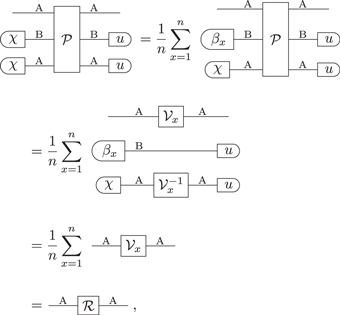
where we have used the fact that  . Finally, let us show that
 is a channel. To this end, it is enough to show that
 [57]. This property is satisfied if and only if
 , because every state lies in some convex decomposition of χ [57]. By the condition of informational equilibrium and equation (B10), we have

so  is a channel. Since every pure channel on a fixed system (here
 ) is reversible [57],
 is reversible. Hence, equation (B10) shows that
 is a basic noisy operation, with environment
 . ■
Appendix C.: Proof of theorem 4
Proof. Let  and
 be diagonalisations of ρ and σ, respectively. We first show that
 implies
 . Suppose that one has
 , where
 is a unital channel. Then

Applying  to both sides, we obtain

Now, the Dij's are the entries of a doubly stochastic matrix D (lemma 2). Hence, equation (C2) implies that  majorises
 .
Conversely, suppose that  and let D be a doubly stochastic matrix such that
 . Define the measure-and-prepare channel

By construction, one has

Now, the channel  is unital by lemma 3. Hence, ρ can be converted into σ by a unital channel.■
Appendix D.: Operational features of doubled quantum theory
Here we summarise the key operational features of doubled quantum theory.
D.1. Doubled quantum theory violates local tomography
An equivalent formulation of local tomography is that the dimension of the vector space spanned by the states of a composite system is equal to the product of the dimensions of the vector spaces spanned by the states of the components [54, 57]. The equality fails to hold in doubled quantum theory, where the dimension of the global vector space is strictly larger than the product of the dimensions of the individual vector spaces. To see why this is the case, note that the block diagonal states of the form (52) span a vector space of dimension  , where d is the dimension of the Hilbert spaces
 and
 . Given two systems
 and
 , the product of the individual dimensions is

On the other hand, each of the Hilbert spaces  and
 in equation (54) has dimension
 . Hence, the vector space spanned by the states of the composite system has dimension

that is, twice the dimension of the vector space spanned by product states.
D.2. Doubled quantum theory satisfies purification
A generic state of a generic system  can be diagonalised as

where  is an orthonormal basis for
 and
 is an orthonormal basis for
 . The state can be purified e.g. by adding one copy of system
 . Since the composite system has two superselection sectors, there will be two types of purification: purifications in the even subspace
 and purifications in the odd subspace
 . A purification in the subspace
 will have the form

where  is an orthonormal basis for
 and
 is an orthonormal basis for
 . A purification in the subspace
 will have the form

where  is an orthonormal basis for
 and
 is an orthonormal basis for
 . Note that any two such purifications are equivalent under local unitary transformations: indeed, one has

where U is the unitary matrix defined by

The same arguments apply to purifications within the same sector and to purifications where the purifying system is not a copy of the original system. In summary, every state can be purified and every two purifications with the same purifying system are equivalent under local unitaries.
D.3. Doubled quantum theory satisfies causality, pure sharpeness, and purity preservation
Causality is immediate: for every system, the only deterministic effect is the identity matrix. Pure sharpness is also immediate: every rank-one projector is a pure sharp effect. As to purity preservation, note that the only pure transformations are quantum operations of the single-Kraus form  . Clearly, the composition of two single-Kraus operations (both in parallel and in sequence) is a single-Kraus operation. In other words, the composition of two pure transformations is pure.
Appendix E.: Permutability versus strong symmetry: the example of the square bit
Consider the square bit [55]. Here the state space is a square, and the pure states are its vertices. The group of reversible transformations is the symmetry group of the square, which is the dihedral group D4. Every pair of vertices is a set of perfectly distinguishable pure states. Figure 3 shows the situation for the pure states

where the third component gives the normalisation. The pure observation-test  , where

is the perfectly distinguishing test for the two sets  and
 .
Now, since every set of perfectly distinguishable pure states has two elements, the only non-trivial permutation of the elements of such a set is the transposition. This permutation can be implemented by considering the reflection through the axis of the segment connecting the two points. Hence the square bit satisfies permutability. On the other hand, the square bit does not satisfy strong symmetry. A counterexample is shown in figure 3. Consider the two maximal sets  and
 . There are no reversible transformations mapping the former to the latter because no symmetries of the square map a side to a diagonal.
Appendix F.: Proof of proposition 10
Proof. The implication ‘strong symmetry  permutability’ follows immediately from the definitions. The implication ‘strong symmetry
 reversible controllability’ was proved by Lee and Selby [63] using causality, purification, and the property that the product of two pure states is pure, which is guaranteed by our purity preservation axiom. Hence, we only need to prove the implications ‘permutability
 strong symmetry’ and ‘reversible controllability
 strong symmetry’
Let us prove that permutability implies strong symmetry. The first part of the proof is similar to the proof of theorem 30 of [70]. Consider two maximal sets of perfectly distinguishable pure states  and
 . Assuming permutability, we will show that there exists a reversible channel
 such that
 , for all i = 1, …, d. First of all, note that the states
 are pure (by purity preservation) and perfectly distinguishable. Then permutability implies there exists a reversible transformation
 such that for all i = 1, …, d [71]

Applying the pure effect  to both sides of the equation we obtain

with

By construction,  is pure (by purity preservation) and occurs with probability 1 on all the states
 . Moreover, the diagonalisation
 implies that
 occurs with probability 1 on every state because
 [57]. Since
 is a pure deterministic transformation on
 , it must be reversible [57]. Hence, equation (F2) proves that the states
 can be reversibly transformed into the states
 . In short, permutability implies strong symmetry.
Let us prove now that reversible controllability implies strong symmetry. Let  and
 be two pure maximal sets of a generic system
 . Since reversible transformations act transitively on pure states, for every
 , one can find a reversible transformation
 that maps
 into
 , in formula

Moreover, reversible controllability implies that we can find a reversible transformation  such that

for every  . Likewise, for every
 , one can always find a reversible transformation
 that transforms
 into
 , in formula

And again, one can find a reversible transformation  such that

for every  . Combining equations (F4)–(F7), we obtain

for every i. Hence, one has

with

By the same argument used in the first part of the proof, we conclude that  is a reversible transformation. Hence, equation (F9) implies that the set
 can be reversibly converted into the set
 . In short, reversible controllability implies strong symmetry.■
Appendix G.: Proof that sharp theories with purification and unrestricted reversibility satisfy the local exchangeability axiom
The aim of this appendix is to prove the following proposition:
Proposition 14. Every sharp theory with purification and unrestricted reversibility satisfies local exchangeability.
Proof of proposition 14. Let  be a generic pure state and let
 and
 its marginal states, diagonalised as

where  for all
 , and
 . Here we are invoking a result of [62], where we showed that the marginals of a pure bipartite state have the same spectrum (up to vanishing elements). Now, we extend the set of eigenstates of
 and
 to two pure maximal sets. Without loss of generality assume
 . By the permutability axiom, there must exist a reversible transformation
 such that

Similarly, there must exist a reversible transformation  such that

At this point, we define the pure transformations


and the pure state

where the purity of  ,
 , and
 follows from purity preservation. Like in the proof of proposition 10, we can prove that
 and
 are in fact channels, so
 and
 . Hence
 and
 have the same marginals. Then, the uniqueness of purification applied to both systems
 and
 (viewed as purifying systems of one another) implies that there exist two reversible transformations
 and
 such that


Hence, we have shown that there exist two local pure channels  and
 that reproduce the action of the swap channel on the state
 . ■
Note that local exchangeability is implemented in this setting by pure channels.
In passing, we also mention that the validity of local exchangeability implies that every state admits a symmetric purification, in the following sense:
Definition 17. [67] Let ρ be a state of system  and let Ψ be a pure state of
 . We say that Ψ is a symmetric purification of ρ if

and

With the above notation, we have the following
Proposition 15. In every sharp theory with purification and unrestricted reversibility, every state of every finite system admits a symmetric purification.
The existence of a symmetric purification for every state is guaranteed by theorem 3 of [67].