
All software applications interact with data, most commonly through a database management system (DBMS). Some programming languages come with modules that you can use to interact with a DBMS, while others require the use of third-party packages. In this tutorial, you’ll explore the different Python SQL libraries that you can use. You’ll develop a straightforward application to interact with SQLite, MySQL, and PostgreSQL databases.
In this tutorial, you’ll learn how to:
- Connect to different database management systems with Python SQL libraries
- Interact with SQLite, MySQL, and PostgreSQL databases
- Perform common database queries using a Python application
- Develop applications across different databases using a Python script
To get the most out of this tutorial, you should have knowledge of basic Python, SQL, and working with database management systems. You should also be able to download and import packages in Python and know how to install and run different database servers locally or remotely.
Free PDF Download: Python 3 Cheat Sheet
Understanding the Database Schema
In this tutorial, you’ll develop a very small database for a social media application. The database will consist of four tables:
userspostscommentslikes
A high-level diagram of the database schema is shown below:
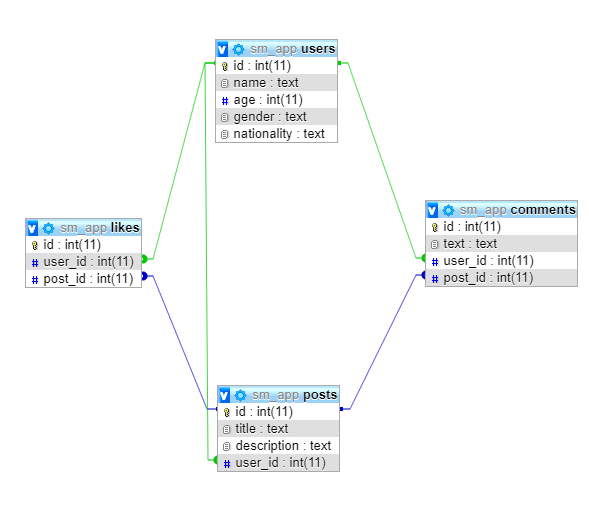
Both users and posts will have a one-to-many relationship since one user can like many posts. Similarly, one user can post many comments, and one post can also have multiple comments. So, both users and posts will also have one-to-many relationships with the comments table. This also applies to the likes table, so both users and posts will have a one-to-many relationship with the likes table.