
LinkedIn Workforce Report | United States | January 2019

Over 190 million workers in the U.S. have LinkedIn profiles; over 30,000 companies in the U.S. use LinkedIn to recruit; over 3 million jobs are posted on LinkedIn in the U.S. every month; and members can add over 50,000 skills to their profiles to showcase their professional brands. That gives us unique and valuable insight into U.S. workforce trends.
This LinkedIn Workforce Report is a monthly report on employment trends in the U.S. workforce. It’s divided into two sections: a National section that provides insights into hiring, skills gaps, and migration trends across the country, and a City section that provides insights into localized employment trends in 20 of the largest U.S. metro areas: Atlanta, Austin, Boston, Chicago, Cleveland-Akron, Dallas-Ft. Worth, Denver, Detroit, Houston, Los Angeles, Miami-Ft. Lauderdale, Minneapolis-St. Paul, Nashville, New York City, Philadelphia, Phoenix, San Francisco Bay Area, Seattle, St. Louis, and Washington, D.C.
Our vision is to create economic opportunity for every member of the global workforce. Whether you’re a worker, an employer, a new grad, or a policymaker, we hope you’ll use these insights to better understand and navigate the dynamics of today’s economy.
Key Insights
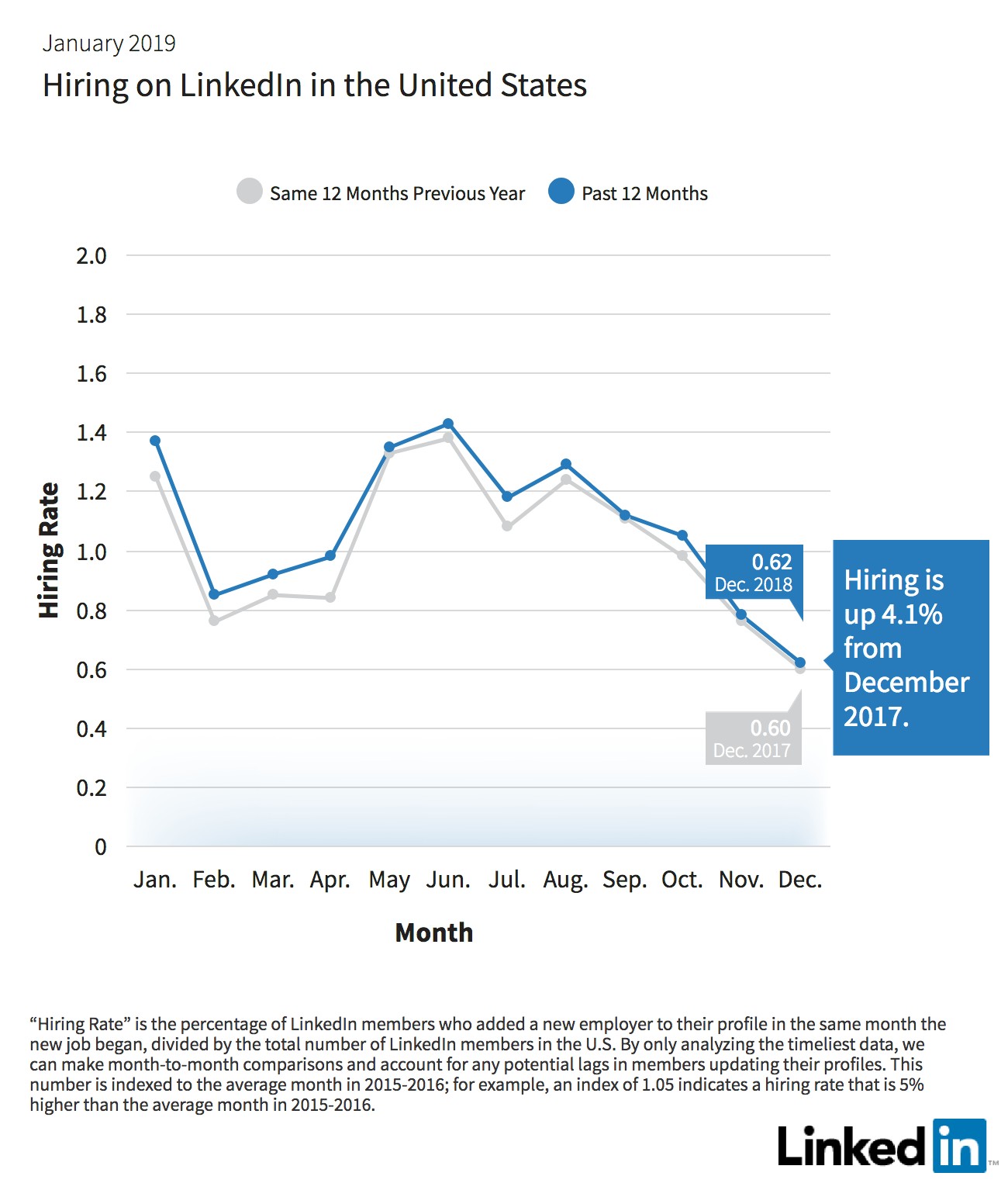
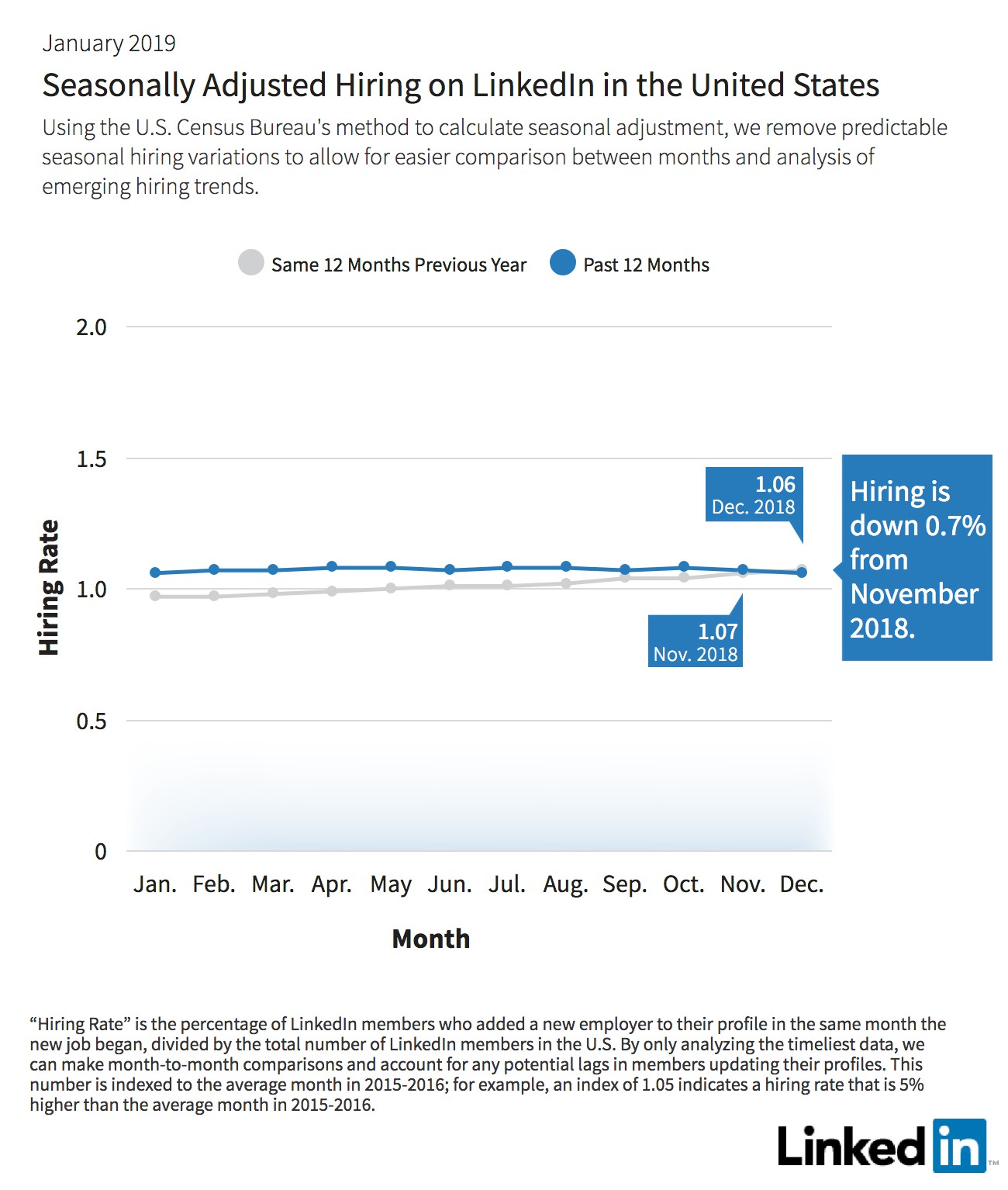
Hiring | U.S. hiring slows modestly - U.S. hiring has moderated since the summer with declines in November and December. Across all industries, national gross hiring in the U.S. was 4.1% higher than in December 2017, but seasonally-adjusted national hiring was 0.7% lower in December from November 2018. The cities with the biggest year-over-year declines in December were Miami-Fort Lauderdale, FL (4.4% lower) and St. Louis, MO (2.4% lower). Despite the overall decline, industries like Software & IT Services (13% higher); Corporate Services (11.5% higher); and Agriculture (11.1% higher) demonstrated significant year-over-year hiring increases in December.
Skills | Business skills surge in importance in traditional finance hubs - It’s not just cutting-edge tech skills that are in high demand. Business management skills - such as strategy, vendor management, and change management - are becoming relatively more important in traditional finance hubs such as New York, Chicago, Boston and Philadelphia. At the same time, finance-related skills have become relatively less important in these regions over the same time period.
- Migration | Coastal workers are meeting in the middle - Austin continues to draw the most workers and has the biggest year-over-year increase in hiring rate of all cities (15.8% higher). For every 10,000 LinkedIn members in Austin, 130 arrived within the past 12 months. This inflow into Austin has coincided with the city’s strong economic growth, and most new arrivals are largely coming from coastal powerhouses like the San Francisco Bay Area (8.1%), and New York City (5.8%).
Hiring | U.S. Hiring Slows Modestly
The LinkedIn hiring rate is a measure of gross hires divided by LinkedIn membership. Nationally, across all industries, gross hiring in the U.S. was 4.1% higher than in December 2017.
Seasonally-adjusted national hiring was 0.7% lower in December from November 2018.
The industries with the biggest year-over-year hiring increases in December were Software & IT Services (13% higher); Corporate Services (11.5% higher); and Agriculture (11.1% higher).
Table 1: Hiring on LinkedIn, by Industry, through December 20