Ben DeGrow is a Senior Policy Director of Education Choice for ExcelinEd.


On Oct. 1, 2026, the U.S. Department of the Treasury released proposed regulations for the Federal Scholarship Tax Credit, which launches Jan. 1, 2027. The program lets individual taxpayers donate to scholarship granting organizations (SGOs) and receive a dollar-for-dollar federal tax credit of up to $1,700. Those organizations then award scholarships to eligible K-12 students. Students can receive scholarships only in states that opt in. The proposed rules give states and education leaders more clarity on how to prepare.
Congress created the Federal Scholarship Tax Credit program in 2025 as part of the broader tax and spending law known as the One Big Beautiful Bill Act. The design follows state educational tax credit scholarship programs, which more than 20 states already operate. How it works: a taxpayer donates to an SGO, receives a tax credit, and the SGO distributes scholarship funds to students for approved education expenses.
What You’ll Learn in this Post
The federal law does not set scholarship award sizes, and it gives the U.S. Department of Education no formal administrative role. The U.S. Treasury Department drafted the proposed regulations, and the public has an opportunity to comment on them through the end of November.
Based on the Treasury announcement and early reporting, the proposed rules include these provisions:
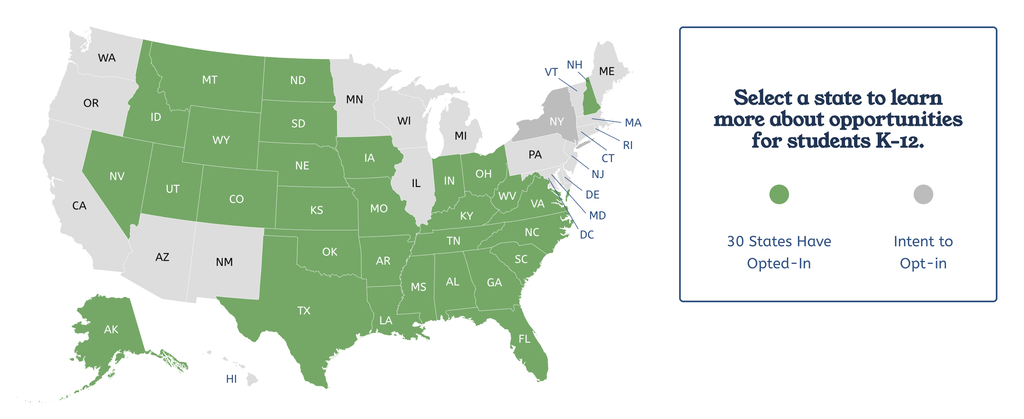
You can explore this interactive map on the Invest in Education Foundation’s website to learn more about how your state is approaching the FSTC.
States can use the clarity in the proposed rules to:
Parents of eligible students in participating states can apply to an SGO for a scholarship. This program allows families to use scholarship funds for expenses associated with enrollment at any recognized school, whether public or private. Depending on the SGO’s award decisions, funds could be applied toward private school tuition, tutoring, special education therapies or other approved costs. Each SGO decides how much to award based on available funds and student needs. Experience with scholarship programs shows that it can take some time for families to learn these opportunities are available, so clear navigation support will be important.
While private school tuition and fees are allowable expenses, public school students can also benefit. A district or charter school student could use a scholarship for tutoring, afterschool programs or special education therapies. Several districts, including Clark County, Nevada; Columbus County, North Carolina; Denver; and Van Buren, Arkansas, have already begun exploring partnerships with SGOs to offer services that scholarship funds could pay for.
States with existing tax credit scholarships, vouchers or education savings accounts have the most experience to build on. Their main task is making sure the federal credit works alongside current programs rather than duplicating them. Useful steps include:
States should look to the Federal Scholarship Tax Credit to supplement support for existing choice programs rather than to take their place.
States with few or no private school options can still use the credit to address opportunity gaps; the federal program can bring scholarship funding to states that have not adopted vouchers or education savings accounts. Governors currently face a decision about whether to opt in between now and the end of the year.
States that decide to opt in can begin by assessing local needs: where students lack access to tutoring, afterschool programs, special education services or learning options that fit their needs. Because the program is built around SGOs rather than state-run accounts, states without existing infrastructure can partner with experienced national nonprofit SGOs and digital platform providers instead of building systems from scratch.
Regardless of how many options families currently have, states can use the credit to help students both outside and inside traditional public schools.
Many families use home education, hybrid models, and microschools. States can review whether their laws serve these learners by considering:
States can identify the district and charter schools and student populations that would benefit most from effective tutoring and afterschool opportunities. State microgrant programs offer models to study, including Texas’s Parent-Directed Special Education Services program and Indiana Learns.
One option states may want to pursue is supporting a statewide, mission-driven SGO. Because the proposed rules prevent states from restricting which SGOs may accept eligible donations, a statewide SGO would be a voluntary, additive approach. It would complement other SGOs rather than limit them. Iowa represents an example of a state already actively pursuing this strategy.
A statewide SGO could focus its mission on high-need students across all school types, including district schools, charter schools, private schools and home and hybrid learners. It could:
States can also promote giving by offering matching grants to any aligned SGO funded through the federal credit. This approach does not require creating a new organization, and it can steer additional resources toward state priorities.
The newly proposed IRS rules explicitly recognize payroll deductions as a viable method for making a tax-credit donation to an SGO. A payroll deduction option could be set up for state employees to contribute to the state-endorsed SGO. States could simultaneously allow their employees a write-in option to contribute to any eligible SGO on the state’s list via the payroll system.
As of October 2026, these rules are in proposed form, meaning the final version may differ. As the program is implemented in the coming years, we hope to see continued emphasis on the separation between the federal administration of the program and how the funding is allocated at the state and local level.
School choice works best when there are many different pathways families can pursue to find what works best for their kids. A one-size-fits-all approach with top-down control will make it challenging for innovative approaches to thrive.
State leaders and stakeholders can take the following steps now:
It is a federal program, set to start Jan. 1, 2027, that gives individual taxpayers a dollar-for-dollar tax credit of up to $1,700 ($3,400 for married couples filing jointly) for donations to scholarship-granting organizations. Those organizations award scholarships to eligible K-12 students.
Students must live in a state that has opted in, be eligible to attend public school in their state, and live in a household with income at or below 300% of area median gross income. EdChoice has created an easy-to-use online tool to find the specific income limits based on family size for each county in the U.S.
According to U.S. Treasury officials, allowable uses include private school tuition, tutoring, special education therapies, books, computers and other expenses connected to enrollment or attendance. Federal officials have not yet provided specific criteria for expenses.
Yes. Students do not have to leave public school. They can use scholarships for tutoring, afterschool programs, special education therapies and similar supports.
No. Governors decide whether to opt in. Students can receive scholarships only in states that opt in by Jan. 1, 2027, though taxpayers in any state can claim the credit. Each year afterward, states can choose to participate.
An SGO is a recognized nonprofit that collects eligible donations and awards scholarships to 10 or more students in two or more schools. Under the proposed rules, SGOs must undergo annual independent audits and may operate in multiple states.
According to federal officials, states cannot block certain types of SGOs from accepting eligible donations or dictate how SGOs direct funds, as long as the SGO meets the basic standards under the federal law.
It is a mission-driven SGO supported by a state, focused on high-need students across all school types. States can also provide matching grants to any aligned SGO.
The proposed rules are open for comment through the end of November 2026.
The proposed rules are published in the Federal Register (document 2026-20277), and the Treasury Department has issued a news release and FAQ. The temporary rules can be found separately in the Federal Register (document 2026-20264).
The proposed rules are intended to cover issues that will need to be addressed by January 1, 2027. The temporary rules are intended to cover issues that need immediate clarity.
According to Treasury officials, final program rules will be available no earlier than 2028.
