News
2026
Dr. Wang, Dr. Grazioli, and SJSU Students Publish Research Study in ACS Biochemistry
July 28, 2026
A collaboration between the labs of Dr. Ningkun Wang and Dr. Gianmarc Grazioli has recently been published in the ACS journal Biochemistry, where they show that an intrinsically disordered region of SIRT1, called motif A, can increase SIRT1 activity when there's a phosphomimetic mutation at a specific phosphoryation site and not others. Molecular dynamics simulations provide clues on how conformation and protein dynamics play a role in this.

SJSU Chemistry Shines at NCURS Conference with an Exceptional Surge of Student Presentations
May 2, 2026
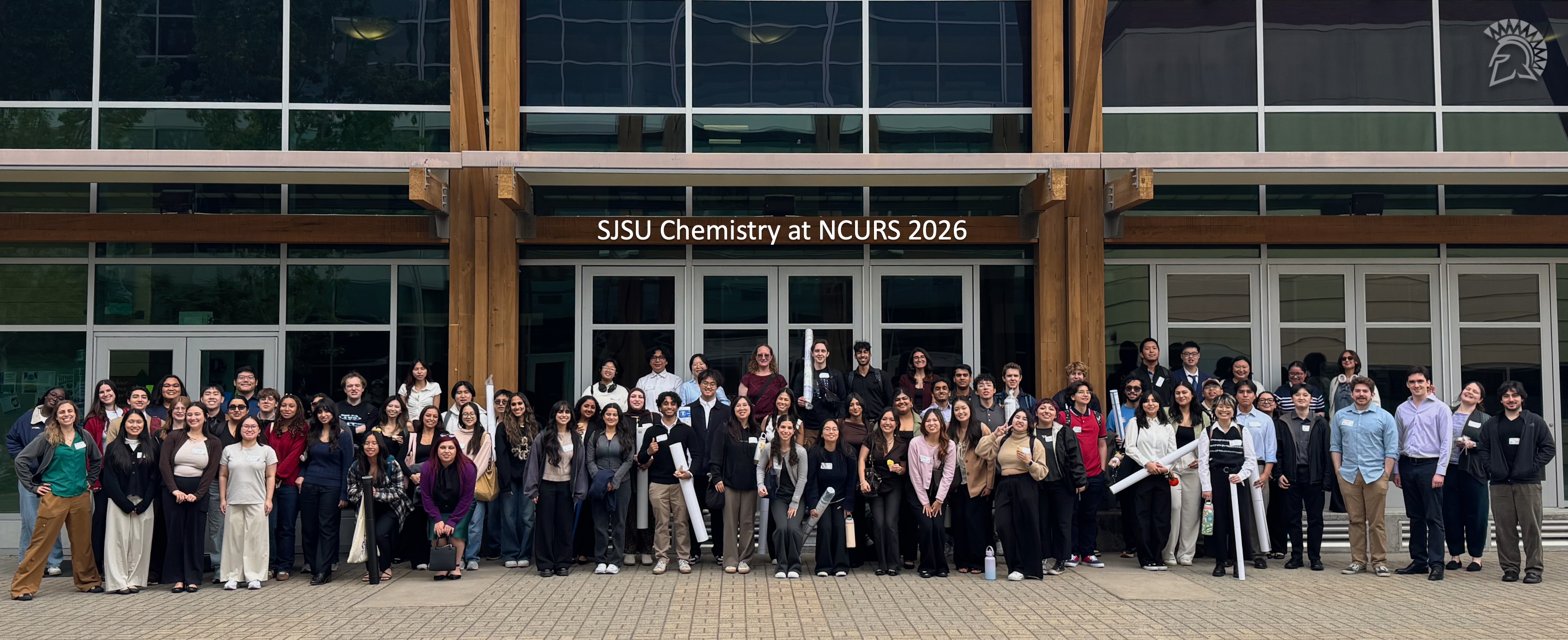
More than 75 students and faculty from the SJSU Department of Chemistry presented their research at the Northern California Undergraduate Research Symposium (NCURS). The conference was hosted by Sonoma State University.
2025
Radlauer Group Publishes ACS Omega Study on Catalysis Reproducibility
Dec. 15, 2025
 Dr. Madalyn Radlauer and her student researchers recently published a study in ACS Omega focused on improving reproducibility in homogeneous catalysis research. The paper,
“Improving Reproducibility of Catecholase-like Catalysis by Investigating Reaction
Conditions and Autoxidation,” examines how reaction conditions and autoxidation can
influence commonly used catalytic oxidation experiments and provides recommendations
for obtaining more reliable and reproducible results across laboratories.
Dr. Madalyn Radlauer and her student researchers recently published a study in ACS Omega focused on improving reproducibility in homogeneous catalysis research. The paper,
“Improving Reproducibility of Catecholase-like Catalysis by Investigating Reaction
Conditions and Autoxidation,” examines how reaction conditions and autoxidation can
influence commonly used catalytic oxidation experiments and provides recommendations
for obtaining more reliable and reproducible results across laboratories.
The publication highlights the significant contributions of undergraduate researchers Dalia Cruz Carbajal, Nicole Caparros, and Lily M. Truong, along with Chemistry M.S. students Brenda Lu and Lily Y. Gordon, all of whom have since graduated. The work was published as part of the ACS Omega special issue, “Undergraduate Research as the Stimulus for Scientific Progress in the USA.”
Celebrated SJSU alum, Prof. William H. Fenical, to Speak at SJSU on Marine Natural Products
Nov. 17, 2025
 William Fenical is the Distinguished Professor of Marine Chemical Biology and Pharmaceutical
Sciences for the Scripps Institution of Oceanography and UC San Diego. A native of
Chicago, Il. Dr. Fenical received his BS in Biochemistry from Cal Poly, San Luis
Obispo, followed by the MS in Chemistry from San José State University. After completing
his PhD degree at UC Riverside, and a brief period working at Shell Oil in Richmond,
he began working at the Scripps Institution of Oceanography (SIO) as Assistant Research
Chemist. At SIO he has developed a highly successful and internationally recognized
program in marine natural products chemistry. Among numerous distinctions, he has
received the Ernest Guenther Prize from the American Chemical Society and the Research
Achievement Award from the American Society of Pharmacognosy. Dr. Fenical has published
over 500 articles in scientific journals and continues working on his research and
publishing papers. Dr. Fenical has mentored 45 PhD students and 48 postdoctoral fellows
in his laboratory. His work has led to numerous seminal discoveries.
William Fenical is the Distinguished Professor of Marine Chemical Biology and Pharmaceutical
Sciences for the Scripps Institution of Oceanography and UC San Diego. A native of
Chicago, Il. Dr. Fenical received his BS in Biochemistry from Cal Poly, San Luis
Obispo, followed by the MS in Chemistry from San José State University. After completing
his PhD degree at UC Riverside, and a brief period working at Shell Oil in Richmond,
he began working at the Scripps Institution of Oceanography (SIO) as Assistant Research
Chemist. At SIO he has developed a highly successful and internationally recognized
program in marine natural products chemistry. Among numerous distinctions, he has
received the Ernest Guenther Prize from the American Chemical Society and the Research
Achievement Award from the American Society of Pharmacognosy. Dr. Fenical has published
over 500 articles in scientific journals and continues working on his research and
publishing papers. Dr. Fenical has mentored 45 PhD students and 48 postdoctoral fellows
in his laboratory. His work has led to numerous seminal discoveries.
Prof. Fenical's talk will be in 207 Washington Square Hall at 4:45pm on Nov. 20, 2025.
Dr. Carroll Publishes Nature Chemistry Paper on Fluorescent Dyes Used to Rapidly Discover Amyloid Probes for Diagnosing Neurodegenerative Diseases
Sep. 15, 2025
 A study led by Dr. Carroll and collaborators at UCSF has developed a rapid method
for discovering potential diagnostic markers of neurodegenerative diseases. This new
approach, published in Nature Chemistry and highlighted in a UCSF press release, uses common fluorescent dyes, like those in LCD TVs, to identify harmful amyloid
fibrils—protein structures linked to Alzheimer's and related neurodegenerative diseases.
This approach yielded promising probes capable of imaging these fibrils even in post-mortem
brain slices of people who had Alzheimer’s disease. Such probes hold the promise of
allowing scientists to distinguish and track these protein aggregates, this work opens
new avenues for understanding how these diseases develop and for designing better
diagnostic and therapeutic tools. Now, Dr. Carroll’s students at SJSU are using these
fluorescent dyes to uncover probes that can identify and track other important factors,
including protein modifications and amyloids involved in cancer progression.
A study led by Dr. Carroll and collaborators at UCSF has developed a rapid method
for discovering potential diagnostic markers of neurodegenerative diseases. This new
approach, published in Nature Chemistry and highlighted in a UCSF press release, uses common fluorescent dyes, like those in LCD TVs, to identify harmful amyloid
fibrils—protein structures linked to Alzheimer's and related neurodegenerative diseases.
This approach yielded promising probes capable of imaging these fibrils even in post-mortem
brain slices of people who had Alzheimer’s disease. Such probes hold the promise of
allowing scientists to distinguish and track these protein aggregates, this work opens
new avenues for understanding how these diseases develop and for designing better
diagnostic and therapeutic tools. Now, Dr. Carroll’s students at SJSU are using these
fluorescent dyes to uncover probes that can identify and track other important factors,
including protein modifications and amyloids involved in cancer progression.
Dr. Emma Carroll wins NIH R16 SuRE-First Research Grant
Sep. 10, 2025
Supported by a new NIH R16 SuRE-First grant award earlier this month, Dr. Carroll's lab is investigating how two critical cancer-fighting
proteins, p53 and PTEN, lose their function. Rather than focusing on genetic mutations,
this research explores how these cellular guardians are inactivated even when their
genetic code is normal. The work will probe several mechanisms, including amyloid
formation, where the proteins misfold into useless clumps; posttranslational modifications,
where chemical "tags" switch them off; and metabolite interactions, where metabolic
byproducts inhibit their function. By pinpointing the exact cellular factors and mechanisms
that cause these critical protectors to lose their function, this work may offer new
strategies for future cancer therapies.

Department of Chemistry Research Open House to Be Held Thursday September 4th
July, 18, 2025
Join us as we kick off the 2025–2026 academic year with a warm welcome to our new and returning students, and a chance to explore the vibrant research happening in our department!
This year’s Welcome Lunch and Research Open House is a great opportunity to meet faculty, connect with student researchers, tour our facilities, and learn more about the exciting projects happening across our 17 research groups. Whether you're a first-year, a transfer, a returning student, or an alum, everyone is welcome!
More information about the event can be found here and you can RSVP by filling out this form.
SJSU Astrobiology Students Earn Honorable Mention at CSU Research Competition
May 19, 2025
Chemistry major Stephen Ball and Biomedical Engineering major Nourdean Shraim won an honorable mention for their research presentation talk entitled “ Life on Earth… from Space.” Ball and Shraim, both from Professor Rios’ SJSU Astrobiology Research group, earned the award at the California State University Student Research Competition, an annual event that brings together scholars from the 23 campuses of the California State University system.

Student Researchers Honored with Awards for Excellence in Science and Athletics
May. 19, 2025
Congratulations to Jacob Bryant and Kathleen Huynh, two outstanding student researchers from Prof. Radlauer's group in the Department of Chemistry, for receiving major honors this spring. Jacob Bryant was recognized at the Undergraduate Research in Polymer Science Symposium with an Outstanding Presentation Award from the ACS Division of Polymer Chemistry for his poster titled "Styrenic Star Polymers Incorporating a Range of Comonomers via RAFT." In addition to his academic achievements, Jacob was also named the 2024–2025 Male Scholar Athlete of the Year at the SJSU Club Sports Awards, a testament to his dedication both in the lab and in the weight room (SJSU NewsCenter article on Jacob). Fellow Radlauer group member Kathleen Huynh was also honored at the Club Sports Awards, receiving the prestigious 2024–2025 Female Athlete of the Year award. Congratulations to Kathleen and Jacob!
SJSU Chemistry Students Featured in Promotional Video for the University
Feb. 13, 2025
A recently made promotional video for SJSU includes some great shots of students in the Radlauer Research Group in action!
Professor Emeritus Daryl Eggers Honored with Article Highlighting his Research Accomplishments at SJSU
Jan. 15, 2025
Dr. Daryl Eggers, Professor Emeritus of Chemistry at San José State University, concluded his tenure with significant contributions to the scientific community, publishing three papers in prominent journals following his retirement in Spring 2023. These publications stem from his extensive research on water's role in chemical reactions and solutions, a pursuit that began during his PhD research at UCLA. Challenging established chemical frameworks, Eggers developed a novel equation to better explain these systems, stating, "I had to step back, think about it and read all the old literature. I derived my own equation that doesn’t exist in any textbook." His dedication not only advanced scientific understanding but also inspired numerous students, including former lab researcher and current SJSU Assistant Professor Alexander Payumo, who regards Eggers as "one of my most influential scientific mentors." Read more about Prof. Eggers's exciting research here.
2024
Prof. Andro Rios and Students Featured in Washington Square Magazine
Oct. 25, 2024
 Professor Andro Rios and his students at SJSU were featured in Washington Square Magazine for their work in astrobiology with NASA through the ASPIRE (Astrobiology Scholars
Program Immersive Research Experience) program. Professor Rios leads a NASA-funded
initiative through the ASPIRE program, designed to foster diversity in space science.
This program connects SJSU and community college students with research internships
at NASA’s Ames Research Center, where they work with ancient meteorite samples and
explore astrobiology. ASPIRE helps students gain hands-on experience and develop careers
in exobiology and space research. Prof. Rios aims to establish a long-term astrobiology
research program at SJSU. Learn more here.
Professor Andro Rios and his students at SJSU were featured in Washington Square Magazine for their work in astrobiology with NASA through the ASPIRE (Astrobiology Scholars
Program Immersive Research Experience) program. Professor Rios leads a NASA-funded
initiative through the ASPIRE program, designed to foster diversity in space science.
This program connects SJSU and community college students with research internships
at NASA’s Ames Research Center, where they work with ancient meteorite samples and
explore astrobiology. ASPIRE helps students gain hands-on experience and develop careers
in exobiology and space research. Prof. Rios aims to establish a long-term astrobiology
research program at SJSU. Learn more here.
Sudharsan Dwaraknath, Co-founder of Quorum Bio, Pioneers Agricultural Biotechnology for Marginalized Communities
Aug. 22, 2024
Sudharsan Dwaraknath, an esteemed alumnus of San José State University (BS Chemistry,
2013), co-founded Quorum Bio, a company at the forefront of agricultural biotechnology.
With a strong focus on addressing global challenges, Dwaraknath's work is centered
on developing technologies that improve crop resilience and productivity, particularly
in regions vulnerable to climate change. His commitment to leveraging science for
social good drives Quorum Bio's mission to enhance food security and sustainability,
making a lasting impact on communities around the world. Dwaraknath's leadership exemplifies
the innovative spirit cultivated at SJSU. To learn more about his journey, read the
full article on C&EN here.
Introducing the Ruth P. Yaffee Endowment Fund
Aug. 20, 2024
During her 35-year tenure, Ruth P. Yaffe taught Honors Freshman Chemistry as well as Analytical Chemistry, Chemical Safety, and Radiation Safety. Among her many achievements, she was the first woman to be tenured in the School of Science. She was also instrumental in the design of the Duncan Hall science building, established and led the Nuclear Science Center, and served multiple terms on university budget, curriculum and recruitment committees and one term chairing the academic senate, all contributing to the development of San Jose into one of the leading California State University campuses for science and engineering.
Ruth wanted to encourage the best students—in particular, women—to pursue science graduate degrees. Over 20 years, Ruth P. Yaffe recommended students to work in the Atomic Energy Commission summer lab with the Livermore Laboratory. In addition she sent about 500 students on to graduate school in science, medicine and law.
The Ruth P. Yaffe Endowment Fund will be a permanent endowment to provide long term, sustaining support to benefit the Chemistry Department, including nuclear science. At the Dean’s discretion the annual endowment distribution may be used for:
- Student research support
- Equipment needs for the Chemistry/Nuclear Science program
- Other uses which will benefit the education and research missions in Chemistry and/or Nuclear Science.
- Student scholarships, with a preference for students involved in research and have demonstrated financial need.
The donors’ preference is for maximum impact, allowing multi-year accumulations of distributions or occasional re-investments back to the principal fund if/when this is deemed desirable. To make a gift supporting the Ruth P. Yaffe Endowment, click here. Make sure to select "Choose a Giving Opportunity" and type in "Ruth P. Yaffee Endowment Fund" in the box.
Professor Esker and SJSU undergrads participate in ground-breaking nuclear chemistry research at LBNL
July 31, 2024
 Prof. Esker, along with SJSU undergraduates Brandon Barrios, Willem Botha, Melanie
Segura Guerrero, and Phu Vo (all members of Prof. Esker's research group) recently
participated in ground-breaking nuclear chemistry research at Lawrence Berkeley National
Lab. The team at Berkeley Lab successfully created element 116 (livermorium) using
a titanium beam, marking a crucial step towards synthesizing element 120. This breakthrough,
reported at the Nuclear Structure 2024 conference, involved a 22-day operation at
the 88-Inch Cyclotron. Creating element 120, which would be the heaviest atom and
part of the "island of stability," requires a titanium-50 beam and a californium-249
target. The project showcases significant advancements in producing superheavy elements,
with potential attempts to synthesize element 120 starting in 2025. Though the publication
is still under peer review, this work has already garnered substantial press coverage
(e.g. Science, Nature, Scientific American) Additionally, a pre-print of the article is available on the arXiv, and full press release describing their work can be found here.
Prof. Esker, along with SJSU undergraduates Brandon Barrios, Willem Botha, Melanie
Segura Guerrero, and Phu Vo (all members of Prof. Esker's research group) recently
participated in ground-breaking nuclear chemistry research at Lawrence Berkeley National
Lab. The team at Berkeley Lab successfully created element 116 (livermorium) using
a titanium beam, marking a crucial step towards synthesizing element 120. This breakthrough,
reported at the Nuclear Structure 2024 conference, involved a 22-day operation at
the 88-Inch Cyclotron. Creating element 120, which would be the heaviest atom and
part of the "island of stability," requires a titanium-50 beam and a californium-249
target. The project showcases significant advancements in producing superheavy elements,
with potential attempts to synthesize element 120 starting in 2025. Though the publication
is still under peer review, this work has already garnered substantial press coverage
(e.g. Science, Nature, Scientific American) Additionally, a pre-print of the article is available on the arXiv, and full press release describing their work can be found here.
Professor Rios and the SJSU Astrobiology Research Group host the UC Davis EAOP program
July 25, 2024
On July 25, twenty high school students from the UC Davis Early Academic Outreach
Program (EAOP) visited SJSU and participated in a summer chemistry engagement activity
with Professor Rios. Dr. Rios and a few of his students from the SJSU Astrobiology
Research Group facilitated a hands-on activity to introduce and demonstrate the relevance
of organic chemistry to everyday life. EAOP participants were also introduced to how
organic chemistry as a discipline advances discoveries to the interdisciplinary field
of science known as Astrobiology. The activity was previously developed by Professor
Rios and allows participants to interact with and develop an appreciation of organic
compounds from terrestrial and extraterrestrial sources in a safe and engaging manner.

Professor Muller is awarded highly prestigious SJSU President's Scholar award for 2023/2024
April 10, 2024
 Professor Gilles Muller Henry Dreyfus Teacher-Scholar in the Departent of Chemistr
at SJSU was recently awarded the prestigious SJSU President's Scholar award for 2023/2024.
The award is in recognition of Prof. Muller's outstanding work as a teacher-scholar
at SJSU. Since joining SJSU in 2004, Chemistry Prof. Muller has secured over $2 million
in funding, mentored nearly 90 students, and published 71 peer-reviewed articles and
43 seminars. Under his mentorship, Prof. Muller's students have co-authored 54 publications
and engaged in international collaborations. An expert in circularly polarized luminescence
(CPL), his collaborations span China, Poland, Spain, and the Czech Republic. CPL,
which involves studying the interaction of circularly polarized light (the electric
field vector of the light rotates in a circular motion as it propagates) with different
molecules of interest, which has applications in chemistry, biology, materials science,
and optics. His lab hosts a diverse group of scholars from various countries and educational
levels. Muller finds joy in both research and teaching, valuing the interplay between
the two. In response to winning the award, Prof. Muller stated "I am honored and grateful
to receive the 2023-24 President’s Scholar Award," he says. "This honor represents
more than just an individual accomplishment; it underscores the significance of collaboration
and the value of engaging students in enriching research endeavors. It serves as a
testament to the remarkable outcomes that arise from collective scholarly efforts,
highlighting the transformative potential when we unite as a community dedicated to
a shared purpose." Prof. Muller has also served as associate dean of research and
chair of the Chemistry Department at SJSU. He expressed gratitude for receiving the
2023-24 President’s Scholar Award, highlighting the importance of collaboration and
student engagement in research.
Professor Gilles Muller Henry Dreyfus Teacher-Scholar in the Departent of Chemistr
at SJSU was recently awarded the prestigious SJSU President's Scholar award for 2023/2024.
The award is in recognition of Prof. Muller's outstanding work as a teacher-scholar
at SJSU. Since joining SJSU in 2004, Chemistry Prof. Muller has secured over $2 million
in funding, mentored nearly 90 students, and published 71 peer-reviewed articles and
43 seminars. Under his mentorship, Prof. Muller's students have co-authored 54 publications
and engaged in international collaborations. An expert in circularly polarized luminescence
(CPL), his collaborations span China, Poland, Spain, and the Czech Republic. CPL,
which involves studying the interaction of circularly polarized light (the electric
field vector of the light rotates in a circular motion as it propagates) with different
molecules of interest, which has applications in chemistry, biology, materials science,
and optics. His lab hosts a diverse group of scholars from various countries and educational
levels. Muller finds joy in both research and teaching, valuing the interplay between
the two. In response to winning the award, Prof. Muller stated "I am honored and grateful
to receive the 2023-24 President’s Scholar Award," he says. "This honor represents
more than just an individual accomplishment; it underscores the significance of collaboration
and the value of engaging students in enriching research endeavors. It serves as a
testament to the remarkable outcomes that arise from collective scholarly efforts,
highlighting the transformative potential when we unite as a community dedicated to
a shared purpose." Prof. Muller has also served as associate dean of research and
chair of the Chemistry Department at SJSU. He expressed gratitude for receiving the
2023-24 President’s Scholar Award, highlighting the importance of collaboration and
student engagement in research.
Professor Rios is awarded a NASA Grant to initiate an Astrobiology Scholars Program between SJSU, Skyline College and NASA Ames Research Center
Apr. 9, 2024
Professor Rios was recently funded to serve as the Principal Investigator(PI) of a
two-year Bridge SEED grant (totaling $331k) for a proposal entitled, “Astrobiology
Scholars Program Immersive Research Experience (ASPIRE)” from NASA Research Announcement
(NRA) NNH23ZDA001N (ROSES-2023), F.23 Bridge Program Seed Funding (BPSF). The SMD
Bridge program’s goal is to develop sustainable partnerships among institutions historically
under-resourced by NASA and NASA Centers or Facilities. The goal of ASPIRE led by
PI Rios is to develop long-term collaborations between faculty and students from SJSU
and Skyline College (a two-year institution in the San Mateo Community College District)
with scientists at NASA Ames Research Center. ASPIRE will leverage the diverse expertise
found within the Exobiology Branch at Ames to give Scholars an opportunity to conduct
research that contributes to two pillars of Astrobiology: origins of life on Earth
and the search for life elsewhere. As a full year immersive program, Scholars participate
in academic year activities focused on mentoring in research and professional development
that enhance their summer research activities. Under ASPIRE, all Scholars are supported
by year-round stipends that match the calculated living wage rate for Silicon Valley.

Professor Rios helps establish a newly funded research collaboration between SJSU and NASA JPL
Apr. 8, 2024

Professor Rios and Dr. Mauro Ferriera Santos at NASA’s Jet Propulsion Laboratory (JPL) received an internal award from the JPL Center for Academic Partnerships for a project entitled, “Establishing a collaboration in life detection science with a new faculty member at San Jose State University'. This funding ($21k for 8 months) will provide opportunities for a student from SJSU to participate in research with Dr. Santos for 10 weeks at JPL in Pasadena this upcoming summer, 2024. The award will also provide funding for Dr. Santos to come to SJSU and for Dr. Rios to visit JPL for generating longer term collaborative projects.
Prof. Eggers Retires with a Flurry (of publications)
Mar. 18, 2024
 Professor Daryl Eggers officially retired from the Chemistry Department in May of
2023, but some of his most important research findings are just now available to the
scientific community. When questioned about the timing of this productivity, Dr. Eggers
stated “I was determined to share these results and ideas with the biophysical community,
and retirement freed up the time to read and think deeply about the work while writing
the manuscripts.” Research in the Eggers Laboratory has focused on understanding the
energetic role of water in binding and conformational equilibria, prompting a new
thermodynamic framework that accounts for the change in solvation energy when two
reactant surfaces make contact with one another. Regarding the new framework, Dr.
Eggers said “our governing equation is viewed as controversial by many biophysical
scientists, but I am hopeful that our approach may one day be recognized as an important
pivot in the application of thermodynamics to solution equilibria. If the scientific
community ever takes notice, these last three papers should become the most cited
works of my career.”
Professor Daryl Eggers officially retired from the Chemistry Department in May of
2023, but some of his most important research findings are just now available to the
scientific community. When questioned about the timing of this productivity, Dr. Eggers
stated “I was determined to share these results and ideas with the biophysical community,
and retirement freed up the time to read and think deeply about the work while writing
the manuscripts.” Research in the Eggers Laboratory has focused on understanding the
energetic role of water in binding and conformational equilibria, prompting a new
thermodynamic framework that accounts for the change in solvation energy when two
reactant surfaces make contact with one another. Regarding the new framework, Dr.
Eggers said “our governing equation is viewed as controversial by many biophysical
scientists, but I am hopeful that our approach may one day be recognized as an important
pivot in the application of thermodynamics to solution equilibria. If the scientific
community ever takes notice, these last three papers should become the most cited
works of my career.”
Link and TOC graphics for three papers:
Supramolecular Chem (https://doi.org/10.1080/10610278.2023.2254442)

ACS Omega (https://doi.org/10.1021/acsomega.3c09329)

bioRxiv (https://doi.org/10.1101/2024.03.15.585270)

Retirement gift from Department:

Prof. Grazioli Publishes Research Paper on an Artificial Intelligence for Simulated Evolution of Models of Amyloid Fibril Formation
Feb. 15, 2024
 The latest article from the Grazioli Research Group (GRG), titled "Genetic Algorithm
for Automated Parameterization of Network Hamiltonian Models of Amyloid Fibril Formation,"
was just published in the American Chemical Society's Journal of Physical Chemistry
B:
The latest article from the Grazioli Research Group (GRG), titled "Genetic Algorithm
for Automated Parameterization of Network Hamiltonian Models of Amyloid Fibril Formation,"
was just published in the American Chemical Society's Journal of Physical Chemistry
B:
https://pubs.acs.org/doi/full/10.1021/acs.jpcb.3c07322

This work is aimed at tackling the timescale gap in simulating protein aggregation leading to amyloid fibrils, which are related to diseases like Alzheimer’s disease and Huntington's disease. The AI-generated coarse-grained molecular simulations, which were optimized using a genetic algorithm - a form of AI that simulates evolution to produce better and better models with each new generation, were shown to exceed previous model performance, and offer insights into possible mechanisms of amyloid fibril formation. The article was co-authored by 3 undergraduate SJSU students: Andy Tao, Inika Bhatia, and Patrick Regan!
This work was supported by a research grant through the National Institutes of Health (1R16GM150706), as well as a CSUPERB research grant through the California State University system.
Additionally, the artwork above, created by Prof. Grazioli, was selected as a supplemental cover for this issue of the Journal of Physical Chemistry B.
Cover art description: Working with artificial intelligence can be a surreal experience. A type of AI called a genetic algorithm is introduced that is capable of discovering network Hamiltonian models (NHMs), which are coarse-grained models of molecular self-assembly, that produce maximal topological structure found in amyloid fibrils (well-known for their association with diseases like Alzheimer’s disease). The algorithm begins with a gene pool of low fibril yield models (represented by the ocean of low fibril yield networks), allows the models to evolve through breeding and natural selection (represented by the tree), and ultimately produces high fibril yield models (the orange and cyan colored networks). The 1,2 2-ribbon network structures shown are the most abundant amyloid fibril topology found in the PDB, exemplified by the protein structure shown behind the tree (PDB ID: 5KK3).
Prof. Resa Kelly is Elected Chair of the ACS Division of Chemical Education and Also Publishes New Article in the Journal of Chemical Education
Feb. 11, 2024
 Prof. Resa Kelly, the newly elected 2024 Chair of the ACS Division of Chemical Education,
began service as Chair-Elect in 2023 when she facilitated the organization of a strategic
planning retreat. Now at the helm of the Division, Kelly is focused on implementing
the Strategic Plan, rallying volunteers, and initiating impactful projects.
Prof. Resa Kelly, the newly elected 2024 Chair of the ACS Division of Chemical Education,
began service as Chair-Elect in 2023 when she facilitated the organization of a strategic
planning retreat. Now at the helm of the Division, Kelly is focused on implementing
the Strategic Plan, rallying volunteers, and initiating impactful projects.
In a notable collaboration with Vicente Talanquer, Kelly recently co-authored a paper published in the Journal of Chemical Education titled: "Thinking and Learning in Nested Systems: The Individual Level." Drawing from conversations held during her sabbatical at the University of Arizona, Talanquer and Kelly explore the dynamics of individual student learning, shedding light on the complexities inherent in this process.
2023
Prof. Wang Publishes Research Paper on the Effects of Resveratrol on SIRT1
August 30, 2023

 The work carried out by Dr. Wang investigates the dual regulatory effects of resveratrol,
a small molecule regulator, on the activity of SIRT1, a crucial enzyme involved in
cellular processes, and addresses the current knowledge gap in understanding the detailed
mechanism of SIRT1 regulation. Our results from enzyme kinetics, protein stability,
protein conformation, and binding studies suggest that the effects of resveratrol
on SIRT1 are not simply on a linear spectrum, from inhibiting to activating. Instead,
we propose that activation and inhibition of SIRT1 by resveratrol are carried out
through two fundamentally different mechanisms. These findings shed light on the intricate
regulatory mechanism of SIRT1 by resveratrol and provide insights into the conformational
changes and substrate interactions underlying the dual effects. This knowledge is
crucial for the development of targeted therapeutics and for assessing potential side
effects of SIRT1 regulators in diseases such as Alzheimer's and diabetes. The study
also highlights the importance of considering multiple peptide substrates in assessing
the effects of regulators, moving beyond the limitations of previous studies that
focused on a few canonical substrates. Overall, this work contributes to our understanding
of SIRT1 regulation and lays the foundation for future research and development of
therapeutic interventions targeting SIRT1 in various diseases. Link to Dr. Wang's Article
The work carried out by Dr. Wang investigates the dual regulatory effects of resveratrol,
a small molecule regulator, on the activity of SIRT1, a crucial enzyme involved in
cellular processes, and addresses the current knowledge gap in understanding the detailed
mechanism of SIRT1 regulation. Our results from enzyme kinetics, protein stability,
protein conformation, and binding studies suggest that the effects of resveratrol
on SIRT1 are not simply on a linear spectrum, from inhibiting to activating. Instead,
we propose that activation and inhibition of SIRT1 by resveratrol are carried out
through two fundamentally different mechanisms. These findings shed light on the intricate
regulatory mechanism of SIRT1 by resveratrol and provide insights into the conformational
changes and substrate interactions underlying the dual effects. This knowledge is
crucial for the development of targeted therapeutics and for assessing potential side
effects of SIRT1 regulators in diseases such as Alzheimer's and diabetes. The study
also highlights the importance of considering multiple peptide substrates in assessing
the effects of regulators, moving beyond the limitations of previous studies that
focused on a few canonical substrates. Overall, this work contributes to our understanding
of SIRT1 regulation and lays the foundation for future research and development of
therapeutic interventions targeting SIRT1 in various diseases. Link to Dr. Wang's Article
NIH Research Grant Awarded to Prof. Grazioli to Develop Computer Simulation Methodology for Studying Amyloid Fibril Formation.
August 25, 2023

Prof. Grazioli was recently awarded a research grant from the National Institutes
of Health (NIH). This award of $714,000 over 4 years will fund a research project
underway in the Grazioli Research Group (GRG) titled "Probing Amyloid Fibril Self-Assembly
with Network Hamiltonian Simulations in Explicit Space," (National Institute of General
Medical Sciences of the National Institutes of Health award number R16GM150706) and
will be focused on developing coarse-grained computer simulation methods for studying
the mechanism of formation of protein aggregates that have been implicated in a number
of human diseases, such as type II diabetes and Alzheimer's disease. This interdisciplinary
project will combine theoretical frameworks from network statistics (exponential-family
random graph models), computational fluid dynamics, statistical mechanics, and artificial
intelligence, and will require Prof. Grazioli and his students to build a custom simulation
software package, which will be made freely available as open source software. Broader
impacts of the work include not only making network Hamiltonian simulations more readily
comparable with experiments, such as dye-binding fluorescence kinetic assays, but
also increasing the capabilities of network Hamiltonian models as a predictive tool
for elucidating the few-body intermolecular interactions from which the molecular
self-assembly into large supramolecular structures are an emergent property.
Project on Diamond and Nitrogen Vacancy Center Photophysics Awarded by NSF
February 27, 2023
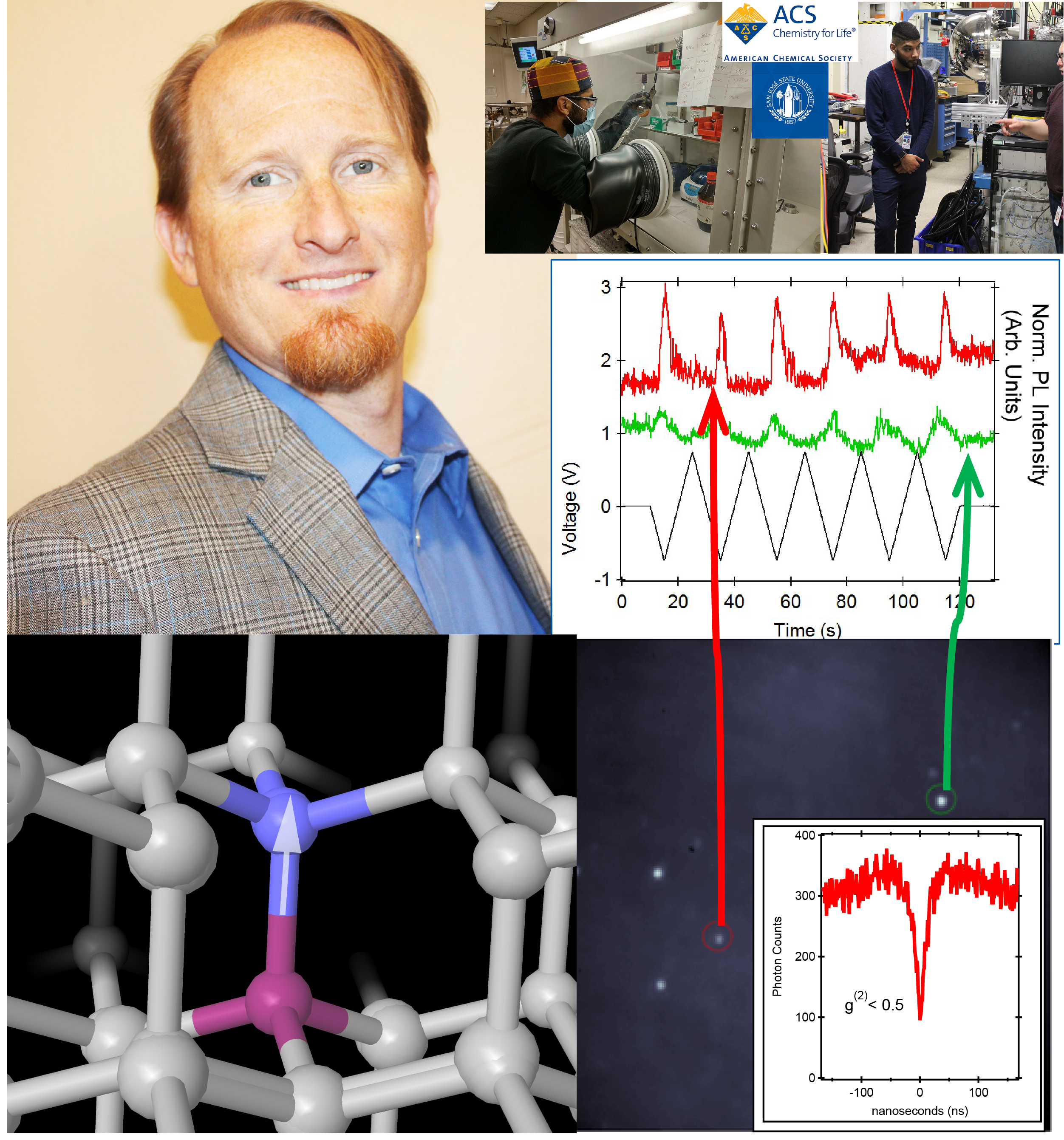
Diamond with its amazing physical properties usually associated with fine gem stones is also an emergent material in photonics, biolabeling and quantum sensing. The surface of diamond, while notoriously difficult to modify, is the target of a recently awarded NSF grant to the lab of Prof. Abe Wolcott (NSF LEAPS). Investigating new surface chemistry and its effect on electric field sensing by the fluorescent nitrogen vacancy center (NVC) are the main aims. NVCs are very sensitive to magnetic and electric fields and can be used in applicationa such as chemical analysis (similar to NMR) and pH sensing. Because the NVC is also a quantum bit, or qubit, it can be used in encoding and transmitting information. The project should have a broad impact in the field of materials science and those using spin defects in diamond for quantum detection. The work will be carried out by an ultradiverse team of researchers and in collaboration with the Black Leadership and Opportunity Center or BLOC.
Prof. Grazioli Publishes an Article on Instructional Activities using his Fluid Simulation Software
February 7, 2023
Prof. Grazioli recently published a peer-reviewed article with 4 SJSU student co-authors
in the ACS Journal of Chemical Education titled "Foregrounding the Code: Computational Chemistry Instructional Activities Using a Highly
Readable Fluid Simulation Code." The article demonstrates two instructional activities for teaching computational
chemistry to students that emphasizes students working directly with computer code.
This approach is motivated by Dr. Grazioli's teaching philosophy that, just as students
of organic chemistry need experience working directly with the chemicals and laboratory
equipment used by professional organic chemists, so too do students of computational
chemistry need experience with one of the professional computational chemist's core
skills: writing code. The activities are centered around a Lennard-Jones fluid simulation
code that Dr. Grazioli wrote in Python to maximize the readability of the simulation
code for students. The article is freely available to the public through the CSU's
open publishing agreement with the CSU, and the simulation code and Jupyter Notebook
for the activity are freely downloadable from Dr. Grazioli's GitHub page.

Prof. Muller Publishes Two Research Papers with Cover Features
January 21, 2023
Prof. Gilles Muller recently published two research papers with two alumni of his
research group in the Dept. of Chemistry at SJSU. One of the papers, published in
the Journal of Materials Chemistry, is titled Tuning CPL by helical pitch modulation
in helically-flexible small organic multichromophores (below top). This work is in
collaboration with Prof. Santiago de la Moya at the Universidad Complutense de Madrid
and involved contributions from Prof. Muller's student Muzuki Johnson. The other paper,
titled Vortex Flow-controlled Circularly Polarized Luminescence of Achiral Pt(II)
Complex Aggregates Assembled at the Air-water Interface Small Methods, was published
in Small Methods (below bottom). That was done in collaboration with Prof. Takeshi
Naota of Osaka University and involved work carried out by Prof. Muller's student
Shing Cho Ma.


2022
Prof. Madalyn Radlauer publishes editoral titled "Games for the Inorganic Chemistry Classroom"
July 27, 2022
Prof. Madalyn Radlauer recently published an editoral titled "Games for the Inorganic
Chemistry Classroom" in the ACS journal Inorganic Chemistry (link). The article highlights educational games as a tool for active learning, also known
as Game-Based Learning, in the chemistry classroom. The article aims to inspire instructors
to consider chemistry games for their classroom and also to consider crafting games
of their own.
July 26, 2022

Undergraduate researcher and recent physics graduate Camron X. Stokes (Fall 2021) in the Wolcott lab has been recognized for research excellence by the American Chemical Society. The award is in recognition of Camron's recent publication, cover art and resulting patent with nanoscale diamond chemistry and a discovering a new route to manipulate the world's toughest material. The Division of Colloid and Surface Chemistry has selected Camron as a COLL-PUI awardee and will give an invited lecture entitled, " Exploiting the metastable brominated diamond surface for amine functionalization with linear, cyclic and branched amine" at the national meeting of the ACS in Chicago, IL this Fall. Along with giving the invited lecture, Camron will also receive his award placard from the Division of Colloid and Surface Chemistry. Congratulations Camron!
Congratulations to the class of 2022!
May 26, 2022

Prof. Esker Wins Nuclear Regulatory Commission (NRC) Early Career Faculty Development Grant
May 20, 2022

Congratulations to Dr. Nicholas Esker, who recently received a Nuclear Regulatory Commission (NRC) early career faculty development grant to support the Esker group’s nuclear science and targetry research. Dr. Nicholas Esker and his group investigate methods to produce and study nuclei far from stability. The proposed project will build the necessary capabilities in SJSU’s Nuclear Science Facility in Duncan Hall to produce thin film samples of low-activity actinides such as thorium & uranium. These thin films, known as targets, are used in low energy nuclear reaction studies to investigate the production and decay of heavy nuclei. An important component in this project is student training, as this support will introduce SJSU students to nuclear science & train them in various thin film production and characterization techniques. Ultimately, the goal of this project is to revitalize the Nuclear Science Facility with a long-term research active faculty.
Prof. Grazioli Wins CSUPERB Faculty-Student Collaborative Research New Investigator Grant
Congratulations to Prof. Gianmarc Grazioli on winning a CSUPERB Faculty-Student Collaborative
Research New Investigator Grant! The New Investigator Grant Program aims to provide
recently hired CSU faculty with the resources required to successfully compete for
follow-on, externally-funded grants and to involve CSU students in their research
programs. This grant will provide salaries to two student researchers, who will work
with Dr. Grazioli over the summer, to develop novel software that leverages network
statistical models and molecular dynamics to simulate the self-assembly of amyloid
fibrils. The formation of amyloid fibrils is central to a variety of human diseases,
such as Alzheimer's disease and Huntington's disease.